Does moisturizing before perfume make it last longer? Short answer: yes, in most cases, and the mechanism is straightforward enough to explain in a paragraph, not just a vague “just trust us” tip repeated across every fragrance blog.
The mechanism, not just the advice
Fragrance longevity depends heavily on what it’s binding to once it lands on skin. Dry skin doesn’t hold fragrance as long as skin with more oil — this is well documented in general perfume literature, not a marketing claim from a lotion brand. A dry surface lets the lighter, more volatile top-note molecules evaporate faster because there’s nothing to slow them down; an unscented moisturizer applied just beforehand gives those molecules something to cling to, extending the whole development arc of the fragrance, top notes through base.
This is the same underlying reason perfume is applied to pulse points — the wrists, the nape of the neck, behind the knees — not just anywhere convenient. Those points combine two things a fragrance benefits from: warmth, which helps release scent continuously instead of in one burst, and (often) slightly higher natural oil content than drier areas like the forearm or shin.
Unscented, not another fragrance
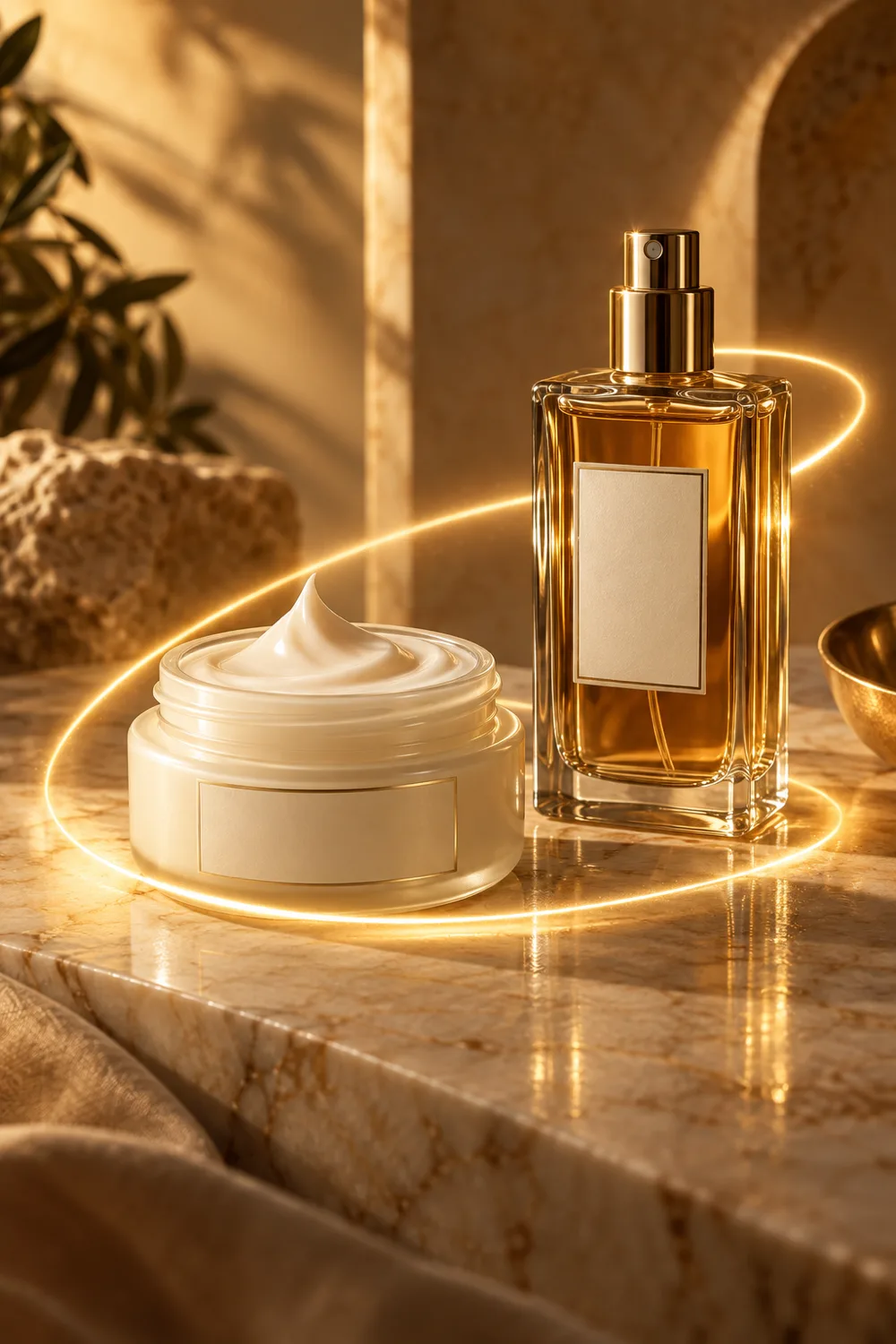
The moisturizer itself matters. A heavily scented lotion competes with the fragrance you’re about to apply, muddying both instead of supporting either — you end up smelling like two things fighting for attention, not one considered scent. An unscented or barely-scented lotion, applied a few minutes before your perfume, does the hydrating work without adding a second competing scent profile. If you want a coordinated layering effect on purpose, that’s a different and deliberate choice — see our guide on how scent layering works for how to do that well instead of by accident.
Petroleum-jelly-based balms are a popular version of this trick among people who’ve tested it seriously: a thin layer at pulse points before spraying, specifically because an occlusive base slows evaporation more than a water-based lotion does. It’s not necessary — a basic unscented moisturizer accomplishes most of the same benefit — but it’s worth knowing if you’re chasing every extra minute of wear from a fragrance you love.
Timing and amount both matter
Applying moisturizer immediately before spraying, versus twenty minutes before, isn’t quite the same. A very fresh, still-slightly-damp layer of lotion can dilute a spray’s initial concentration a little, softening the opening notes more than some people want. Waiting a few minutes for the moisturizer to absorb mostly (not completely) tends to give the best balance: enough residual hydration to help retention, without visibly wetting down the spray on contact.
Amount matters too. A thick, heavy layer of any lotion can trap so much moisture that it changes how a spray sits on the skin, sometimes making it feel slightly muted at first. A normal, moderate application — the amount you’d use for basic skincare, not a spa treatment — is enough to get the longevity benefit without altering the fragrance’s opening character.
Does this work the same for every fragrance concentration?
| Concentration | Typical duration on dry skin | Effect of pre-moisturizing |
|---|---|---|
| Cologne / EDC | Around 2 hours | Noticeable extension, since it starts from a shorter baseline |
| Eau de toilette (EDT) | 2 to 4 hours | Meaningful extension, especially on naturally dry skin |
| Eau de parfum / parfum | Up to 6 to 8 hours | Smaller relative gain, since higher concentrate already lasts longer on its own |
The lighter the concentration, the more a pre-moisturizing routine tends to help in relative terms — which makes it a particularly good habit for anyone who’s found their favorite EDT fading faster than they’d like, before reaching for a stronger (and pricier) concentration as the only fix.
What moisturizing won’t fix
It’s not a universal solution. If a fragrance’s problem is that it’s built from mostly light, fast-evaporating top notes with a thin base structure, no amount of skin prep will turn it into an all-day scent — moisturizing extends what’s already there, it doesn’t restructure the formula. Climate matters too: on a hot, dry day, evaporation happens faster across the board, and pre-moisturizing helps less than it would in cooler, more humid conditions where evaporation is naturally slower to begin with. For more on that side of the equation, see our guide on how weather and humidity change the way fragrance wears.
And it’s worth being honest that individual skin chemistry still has the final word. Two people can follow the identical routine — same moisturizer, same fragrance, same amount — and get noticeably different results, because skin pH, natural oil production, and even diet all play a role in how a fragrance reads and how long it holds on a given person.
A simple routine to test this yourself
- Pick one fragrance you already know reasonably well.
- On day one, apply it to dry, unmoisturized pulse points and note roughly when you stop noticing it.
- On day two, apply a thin layer of unscented lotion to the same pulse points, wait a few minutes, then apply the same amount of fragrance in the same spots.
- Compare the two days honestly — most people notice at least some difference, but the size of the difference varies a lot by skin type, so this tells you more about your own skin than any general claim could.
How this interacts with concentration choice
If you’ve already read up on the difference between EDT, EDP, and parfum concentrations, pre-moisturizing is a useful lever precisely because it’s cheap and reversible, unlike buying a whole new bottle at a higher concentration just to solve a longevity complaint. Try the moisturizing routine first on a fragrance you already own and like — it costs nothing but a few minutes, and if it closes most of the gap, you’ve saved yourself an unnecessary upgrade purchase. If it only helps marginally, that’s useful information too: it tells you the formula itself, not your skin prep, is the limiting factor, and a higher-concentration version (or a different fragrance built with a heavier base structure) is the more effective fix.
Quick answers
Can I use my regular scented body lotion instead of unscented? You can, but expect the fragrance to change character, not just last longer — you’re layering two scents whether you intend to or not.
Will moisturizing make a fragrance stronger, not just longer-lasting? Slightly, in the short term, since a damp base can soften initial projection a touch — but the bigger effect is duration, not intensity.
Does this apply to hair too? Hair holds scent differently than skin (it’s porous and doesn’t have the same oil or heat profile), so a fragrance sprayed lightly on dry hair can last a surprisingly long time on its own, independent of any skin-moisturizing routine.
What ingredients to look for in a pre-fragrance moisturizer
Not every moisturizer serves this purpose equally well. A few practical notes on what to reach for:
- Fragrance-free, not just “unscented light scent.” Some products labeled “unscented” still carry a faint masking fragrance to cover the smell of their base ingredients — check the ingredient list for a true fragrance-free formula if you want zero interference.
- Simple, occlusive-leaning formulas outperform very light, fast-absorbing gels. A gel that vanishes into skin in seconds doesn’t leave much behind for a fragrance to bind to; a slightly richer cream or balm-style moisturizer holds more moisture at the surface, which is the whole point here.
- Petroleum jelly or a similar occlusive balm is the most aggressive version of this trick, favored by people chasing maximum longevity from an expensive bottle. A thin layer at pulse points, nothing more — too much can feel greasy and doesn’t add proportional benefit.
- Avoid alcohol-heavy toners or aftershaves right before spraying. Alcohol dries skin quickly and can strip away exactly the moisture layer you’re trying to build, working directly against the goal.
A note on shower timing
A related, often-repeated tip is applying fragrance right after a shower, while skin is still slightly warm and a little more receptive to product. There’s some real logic here — warm, freshly hydrated skin (assuming you’ve moisturized after toweling off) combines two of the longevity factors already covered: warmth for continuous release, and moisture for better retention. The catch is timing: skin that’s still damp, not just warm, can dilute a spray on contact the same way overly-wet lotion can. Waiting until skin is dry to the touch but still warm from the shower tends to be the sweet spot.
The takeaway
Moisturizing before perfume is one of the few pieces of common fragrance advice that holds up under scrutiny, because it’s built on a real, well-documented mechanism: hydrated skin holds fragrance longer than dry skin does. It’s not a fix for every longevity complaint, and it won’t turn a thin formula into a heavyweight — but for the specific, common problem of a favorite scent fading faster than you’d like, it’s a low-cost, low-effort habit worth building in.
Source: Wikipedia, “Perfume” — sections on skin hydration, dryness, and fragrance longevity, and on pulse-point application.