Ever notice that the same perfume seems to fade by lunchtime on some days and is still going strong at dinner on others — even when you’re sure you applied the same amount? Most people blame the bottle, or assume they just got a bad batch. Usually it’s neither. It’s almost always about where the perfume landed and what the skin underneath it was doing.
The good news is that none of the actual fix requires spending more money or replacing a bottle you already like. It’s almost entirely about technique — where you apply, what’s underneath the fragrance when you do, and a couple of habits that are easy to unlearn once you know they’re working against you.
What a Pulse Point Is
A pulse point is any spot on the body where a blood vessel runs close enough to the skin’s surface that you can feel it beating — the wrist, the side of the neck, behind the ear. These spots run measurably warmer than the rest of your skin, because that blood flow is close to the surface. Perfume is built from volatile compounds: materials that evaporate at room temperature to release their scent into the air. Warmer skin speeds that evaporation up. In practical terms, a pulse point acts like a small, continuous diffuser — the extra warmth keeps releasing scent molecules for longer than a cooler patch of skin would, instead of letting them evaporate in one quick burst right after you spray.
The Pulse Points Worth Using
- Inner wrists — the most common choice, easy to reach, easy to refresh during the day.
- Base of the throat / lower neck — sits close to your face, so you (and anyone close to you) catch the scent more easily than from the wrist.
- Behind the ears — a smaller dose goes a long way here; it’s close to the nose without being overwhelming.
- Inner elbows — often skipped, but effective, especially for a scent you want to keep close to the body instead of projecting outward.
- Behind the knees — unconventional, but useful in warm weather or for a lighter fragrance you want to last without being loud.
You don’t need all five. Two, applied deliberately, outperform five applied carelessly — more on that below.
Why Skin Type Changes Everything
Pulse points explain part of the longevity story. Skin type explains most of the rest. Dry skin holds fragrance for a noticeably shorter time than skin with more natural oil, because oil on the skin’s surface slows the same evaporation process that pulse-point warmth speeds up — the two effects are pulling in opposite directions, and your actual skin is some combination of both. This is also the entire logic behind prep layering: applying an unscented, moisturizing lotion before your perfume gives the fragrance something oil-based to cling to, which is why the same perfume so often lasts visibly longer over moisturized skin than over bare, freshly-showered skin.
If you tend to run toward dry skin, don’t take this as a sign you need a different perfume — it usually just means you need a different application routine, starting with the “moisturize first” step covered below.
Application Mistakes That Quietly Cut Longevity Short
Rubbing your wrists together
This is probably the single most common fragrance mistake, and it comes from a reasonable instinct — it feels like you’re “setting” the scent in. In practice it generates friction heat that breaks down some of the more delicate top-note molecules before they’ve had a chance to develop properly, which is part of why a perfume that’s been rubbed in can smell noticeably different — often flatter — than the same perfume left alone.
Spraying only onto clothing
Fragrance does last longer on fabric than on skin in one narrow sense — fabric doesn’t have body chemistry breaking the scent down the way skin does. But it also skips the pulse-point warming effect entirely, and it can shift how the scent reads over time as fabric doesn’t develop the same way skin does. Clothing is a fine supplement to skin application; it’s a weaker substitute for it.
Spraying from too far away
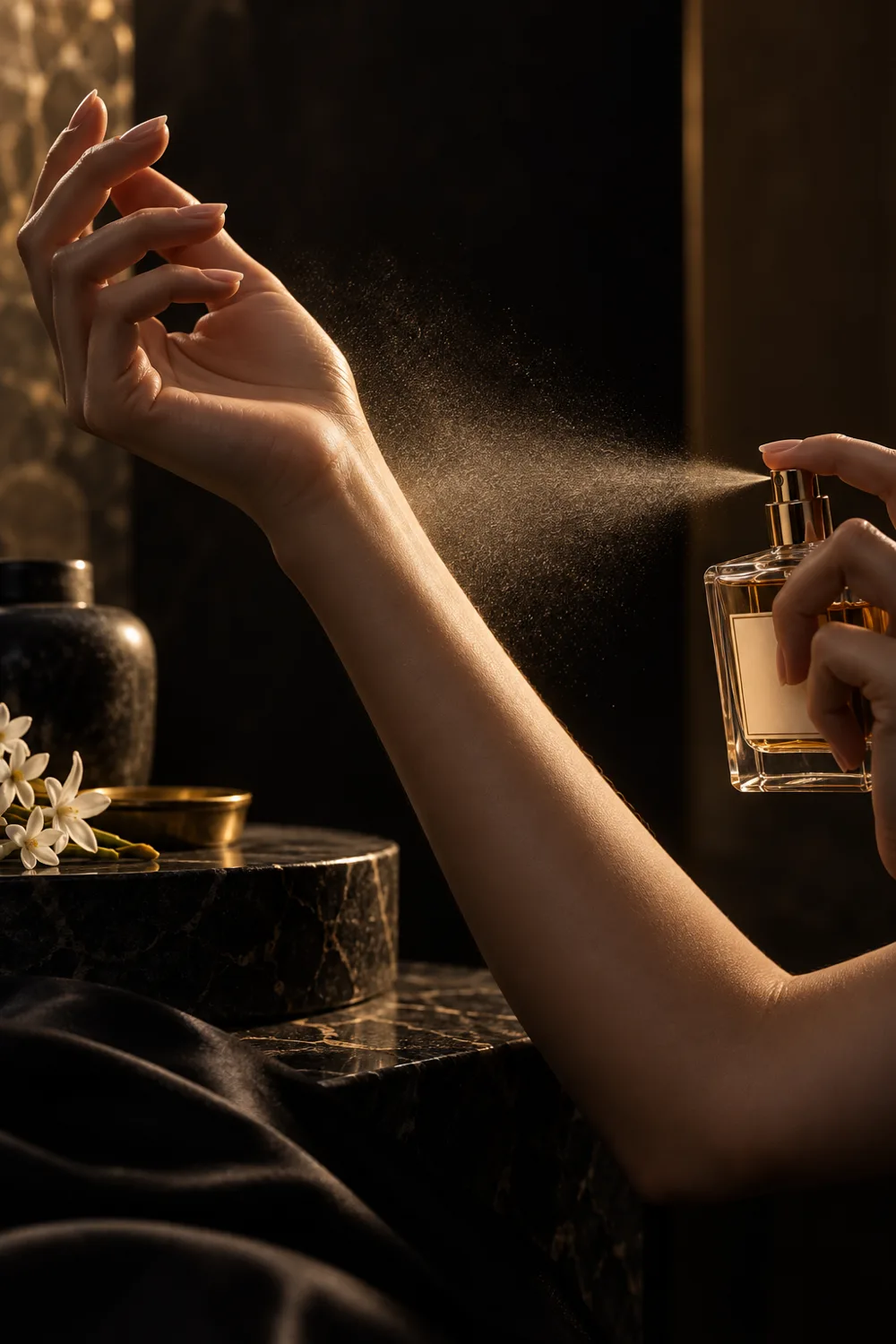
Holding the bottle six or eight inches back to get “even coverage” mostly means more of the fragrance ends up in the air and on the floor than on you. Close the gap to two or three inches so more of what you’re spraying lands where you intend it to.
Skipping bare, unmoisturized skin entirely
Straight onto dry skin, with nothing underneath it, is the fastest way to watch a fragrance’s lifespan shrink — see the skin-type section above.
A Simple Application Routine
- Shower or wash the areas you’ll be applying to, if possible — clean skin holds fragrance more evenly than skin with residue from the day.
- Apply an unscented or same-family lotion to pulse points while skin is still slightly damp.
- Let the lotion absorb for a minute or two — don’t rush this step.
- Spray perfume directly onto two or three pulse points, holding the bottle two to three inches from skin.
- Let it dry down on its own. Don’t rub, don’t fan, don’t blow on it.
If you’re layering a second fragrance on top — see our full guide to scent layering — apply the heavier anchor scent first, wait for it to dry down, then add the lighter accent to a different pulse point, not directly on top of the first.
Does the Fragrance Itself Change How Long This Matters?
Somewhat. Heavier fragrance families — Oriental, Woody — are built on base materials that evaporate slowly regardless of where you put them, so good pulse-point technique extends an already-long lifespan even further. Lighter families — Citrus, Fresh — are working with more volatile materials from the start, so application technique makes a proportionally bigger difference: it’s the gap between a citrus fragrance lasting ninety minutes and lasting four hours.
Adjusting for Weather
Pulse-point technique isn’t static across the year. In warm weather, skin is already running hotter and pulse points are doing extra evaporation work on their own, which is part of why a fragrance can feel like it “blows out” fast in summer heat — you may want fewer pulse points and a lighter hand, letting the ambient warmth do more of the work. In cold weather, the opposite problem shows up: skin runs cooler, pulse points generate comparatively less heat, and a fragrance that performed well in September can feel muted by December even with identical application. This is one of the reasons a fall/winter fragrance rotation often leans on heavier families in the first place — they need less help from body heat to stay noticeable, which matters more once the weather cools down and your skin’s natural warmth is doing less of the lifting.
Common Longevity Myths, Checked
| Claim | Reality |
|---|---|
| “Spraying in your hair makes it last all day” | Hair holds scent differently than skin — often longer, since it isn’t affected by body chemistry the same way — but it can also dry hair out over time and isn’t a substitute for skin application, just a supplement to it. |
| “Expensive perfume always lasts longer” | Price reflects ingredients and brand positioning, not automatically concentration or base-note weight. A well-built drugstore Oriental can outlast a poorly-structured luxury Fresh scent. |
| “You should reapply every 2 hours no matter what” | Reapplication should follow what you can still smell (or what others tell you), not a fixed clock — over-application is as much a real mistake as under-application. |
| “Rubbing it in helps it absorb and last longer” | Covered above — friction heat degrades delicate top notes instead of helping them set. |
Quick Answers
Should I apply more perfume if it’s not lasting? Try fixing application first — moisturizing, correct pulse points, not rubbing — before assuming you simply need more product. More perfume compounds the same mistakes instead of fixing them.
Is it true that pulse points make a scent smell different than it does on a fragrance strip? Yes, and this is normal — body heat and skin chemistry are actively part of how the fragrance develops, which a paper strip can’t replicate. Always judge a fragrance on skin, not on the card a store hands you.
How often should I reapply during the day? There’s no universal number — it depends on the family and your skin — but if you can no longer smell it on yourself at all (not just faintly), a light reapplication to one pulse point is a reasonable call.
Does it matter which pulse point I reapply to later in the day? Not strictly, but switching to a fresh pulse point instead of re-spraying the same one can give a slightly cleaner result, since the original spot may already have some dried-down residue sitting on it from the morning application.
None of this requires more product or a different bottle, and none of it is complicated enough to need a special occasion to try. It’s mostly about giving what you already own the right conditions to perform, starting with the next time you get dressed.