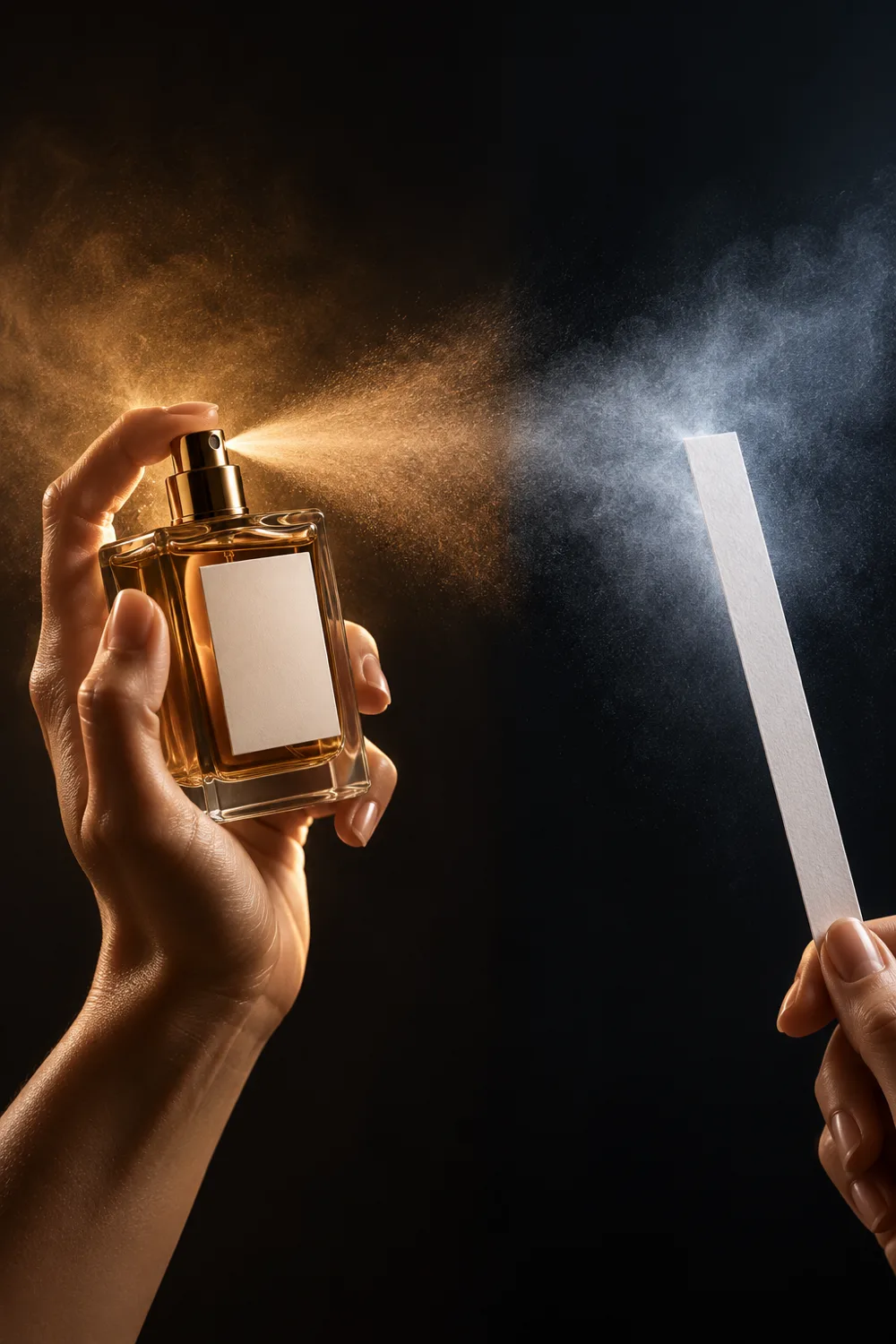
A paper strip, or “blotter,” is a thin, unscented card that fragrance counters use for quick comparisons. It’s a useful tool for a first impression, and a surprisingly misleading one for a final decision — because a fragrance on paper and the same fragrance on skin are, chemically speaking, two different experiences.
What the paper strip measures
Paper is inert. It has no oils, no moisture, no warmth, and no bacteria — nothing for the fragrance’s molecules to interact with beyond simple evaporation into open air at room temperature. What you smell on a strip is close to the fragrance’s “pure” evaporation curve: top notes first, heart notes as the top fades, base notes arriving last. It’s a clean, repeatable read, which is exactly why counters use it for side-by-side comparisons.
But that cleanliness is also the limitation. A strip can’t show you how a scent behaves once it’s introduced to something alive.
Skin changes the chemistry, not just the vibe
Skin has heat, moisture, natural oils, and its own microbiome — all of which interact with fragrance compounds in ways paper simply can’t replicate. According to Wikipedia’s overview of perfume, the relative dryness of a person’s skin directly affects how long a fragrance holds: dry skin doesn’t retain fragrance as long as skin with more natural oil. That single variable is enough to make an identical spray last noticeably longer on one person than another.
Warmth matters just as much as moisture. Perfume is traditionally applied to pulse points — the nape of the neck, the wrists, behind the knees — specifically because the pulse point’s warmth helps release fragrance continuously instead of in one initial burst. A paper strip has no pulse and no body heat, so it misses this slow-release effect entirely.
Body chemistry adds a third layer: everyone’s skin carries a slightly different balance of natural oils and pH, and that balance interacts with individual aromatic compounds in ways that can shift how a note reads. This is the real explanation behind “it smells different on me” — it’s not superstition, it’s chemistry specific to your own skin.
The note pyramid behaves differently on each surface
Every fragrance is built in layers — top, heart, and base — and each layer evaporates at a different rate. Top notes are made of small, light molecules that evaporate quickly, which is why they’re the first thing you smell and the first thing to fade, on either paper or skin. Base notes are heavier and slower, typically not fully perceptible until roughly half an hour after application.
On paper, this progression happens in isolation, unaffected by anything except ambient air. On skin, the same progression is sped up or slowed down by heat and moisture, and it’s layered on top of your own natural scent — which paper doesn’t have. That’s why a fragrance that smells sharp and one-dimensional on a strip can round out into something warmer and more complex once it’s had thirty minutes on your wrist.
| Factor | Paper strip | Skin |
|---|---|---|
| Temperature | Room temperature, static | Body heat, especially at pulse points |
| Moisture / oil | None | Varies by individual, affects longevity directly |
| Base scent underneath | None | Your own skin chemistry |
| Evaporation pattern | Clean, consistent top-to-base progression | Same progression, but sped up by heat and blended with your skin |
So what should you trust a paper strip for?
Not nothing — just not the final call. A strip is a legitimate, fast way to rule things out: if the top notes on paper are already unpleasant to you, skin isn’t going to rescue it. Counters and online sample sellers use strips for a reason; they’re quick, cheap, and consistent across many fragrances in a row.
What a strip can’t tell you is longevity, how the base notes will round out against your own chemistry, or whether the fragrance will read as too strong or too faint on you specifically. For that, there’s no substitute for skin time.
A simple testing routine that respects both tools
- Use paper strips to narrow a long list down to a handful of genuine contenders — this is where a strip’s speed is an advantage, not a limitation.
- Apply your shortlist to skin, one at a time, on different days if possible, so you’re not comparing competing scents on the same skin at once.
- Wait at least thirty minutes before judging — this is roughly when base notes start to show up, and it’s often where a fragrance either earns its reputation or loses it.
- Go about a normal day instead of sitting still and sniffing your wrist every five minutes — see how it reads over hours, not just on first application.
If you’re building out a full fragrance wardrobe without overspending, this two-step process (strip first, skin second) is one of the most effective ways to avoid an expensive mistake — you filter cheaply before you commit to a full bottle.
Why a fragrance can smell “too strong” on paper but fine on skin
Paper has no way to disperse a scent the way open air around a moving body does. When you hold a strip an inch from your nose, you’re getting a concentrated, static dose of whatever’s evaporating off it at that exact moment — usually the top notes, which tend to be the sharpest and most attention-grabbing part of a composition. On skin, that same fragrance is diluted by distance, movement, and the surrounding air, and it’s competing with (and blending into) your own scent instead of sitting alone on an inert surface. This is why a fragrance that seems overwhelming on a strip can turn out to be perfectly reasonable, even understated, once it’s on you and you’re standing a normal conversational distance from another person.
The reverse can also happen, though less often: a fragrance that reads as quiet and forgettable on paper can bloom into something with real presence once skin warmth is pushing it into the air continuously instead of releasing it all at once. Neither direction is a flaw in the fragrance — it’s just two different delivery systems producing two different experiences from the same formula.
Quick answers
Should I ever trust a strip’s read on longevity? No. Longevity is a skin-specific outcome shaped by your own moisture, oil, and heat — a strip sitting on a counter tells you nothing about how long a scent will last on your particular skin.
Why do stores rely on strips instead of just letting people try things on skin? Speed and hygiene, mostly — a strip lets a shopper compare a dozen fragrances in a few minutes without needing to wash their wrists between each one, which skin testing requires for a clean comparison.
Is it worth asking for a skin sample instead of a strip? Yes, when it’s offered. Many counters and most online sample sellers will apply to skin or provide a small vial specifically so you can test at home over a full day — take that option whenever it exists.
Nose fatigue makes strip testing worse the longer you go
There’s a practical failure mode that has nothing to do with paper versus skin: smelling too many strips in a row. Your sense of smell adapts quickly to repeated exposure, a phenomenon sometimes called olfactory fatigue — after five or six fragrances in a row, your nose starts losing its ability to distinguish fine differences between them, and everything starts to blur together. This is a separate problem from the paper-versus-skin issue, but it compounds it: a shopper doing rapid-fire strip comparisons is testing an increasingly unreliable sense of smell on top of an already limited testing surface.
Coffee beans at fragrance counters exist for exactly this reason — sniffing coffee is a common (if only partially effective) way to reset your nose between tries. A more reliable fix is simply testing fewer fragrances per session: three or four is a reasonable limit before your judgment starts to degrade, with a break of at least a few minutes, ideally outdoors, before continuing.
One more wrinkle: skin isn’t static either
Your own skin chemistry isn’t fixed day to day. Diet, medication, hydration levels, and even the products you’ve layered underneath a fragrance can all shift how it develops — the same bottle can read slightly differently on a well-hydrated morning versus a dehydrated one. This is part of why testing on skin over a real day, not just a single sniff at the counter, matters more than any strip ever could. It’s also why scent layering works the way it does — you’re not just combining two fragrances, you’re combining them with a skin surface that’s already changing the outcome on its own.
The takeaway
A paper strip and your skin aren’t measuring the same thing, and treating them as interchangeable is the single most common reason people end up with a bottle that disappointed them at home. Use the strip to screen out the obvious no’s quickly, then give your real skin the final vote — it’s the only surface the fragrance will ever be worn on.
Source: Wikipedia, “Perfume” — sections on application, skin hydration and longevity, and the top/heart/base note structure.