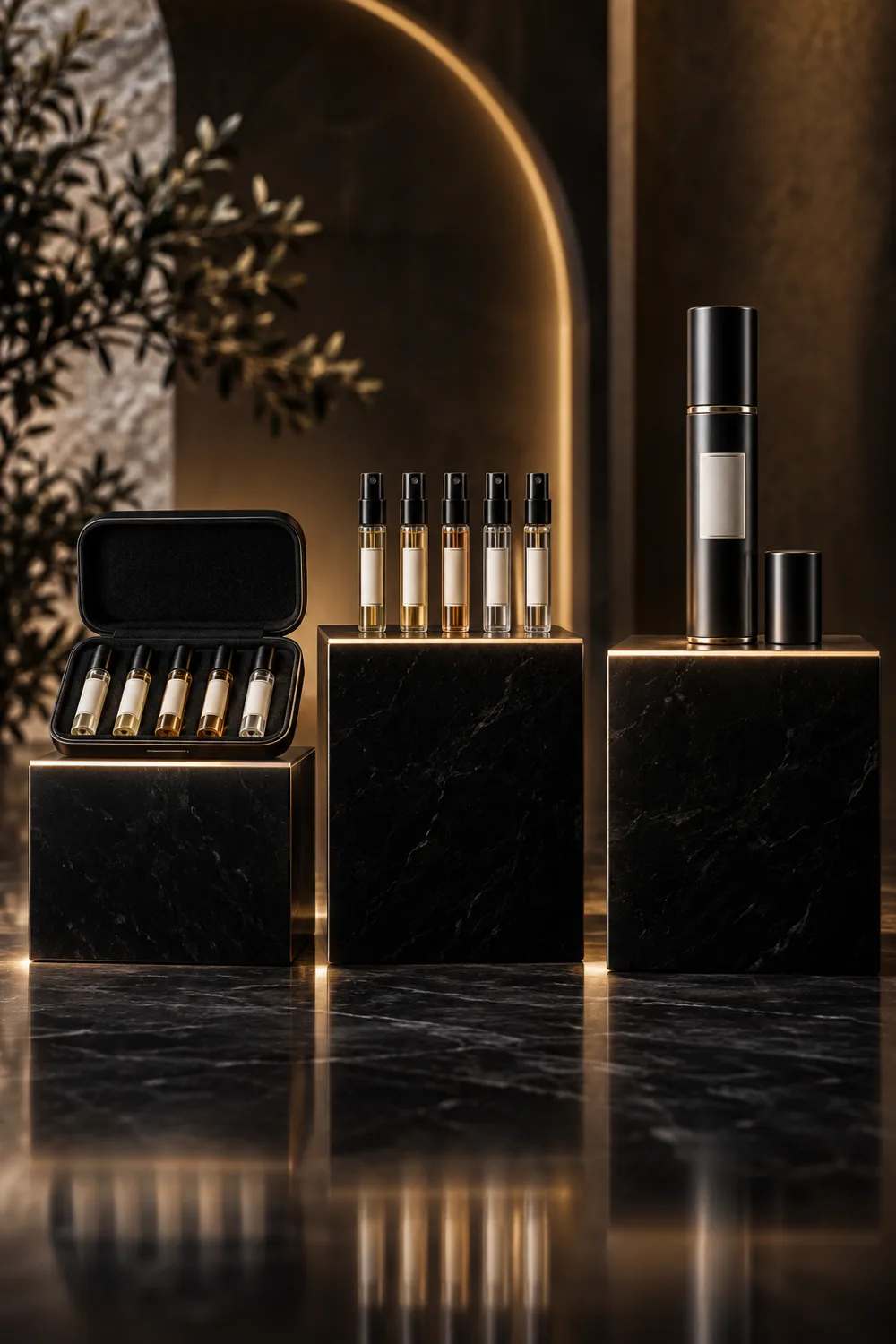
- Buy sample sizes or decants before committing to a full bottle on anything unfamiliar.
- Track what you already own before buying anything new.
- Spend more on the pieces you’ll wear constantly, less on the ones you’ll wear occasionally.
- Ignore “limited edition” urgency — it’s a sales tactic, not a real scarcity signal in most cases.
- Let concentration, not brand prestige, guide how much you’re paying for.
That’s the short version. None of it is complicated, and none of it requires giving up a fragrance habit you enjoy — it just means spending on purpose instead of by impulse. The rest of this guide is the reasoning behind each item, plus a few things that trip people up specifically in this category.
Start with an honest inventory
Before adding anything new, it’s worth counting what you have and being honest about what gets used. A quick way to do this: line up every bottle you own and sort into three piles — reached for regularly, occasional/seasonal, and untouched for six months or more. That third pile is the most useful information you’ll get in this whole process. It tells you, concretely, what kind of purchase you’re prone to regretting, whether that’s a pattern of buying trend-driven scents that don’t hold up, duplicating a profile you already own several versions of, or getting talked into something at a counter that never fit your daily life.
This step matters more than any individual buying tip below, because most fragrance overspending isn’t the result of any single bad purchase — it’s the accumulation of untouched bottles bought without checking against what’s already on the shelf.
Understand what you’re paying for
Fragrance pricing isn’t as opaque as it can feel, once you know what’s driving it. Concentration is the biggest lever: a parfum or extrait uses a higher percentage of concentrated oil than an EDT or EDP of the same scent, which means more raw material cost per bottle — often the real reason a “stronger” version costs noticeably more, independent of brand. Bottle size matters in the obvious way, but larger bottles usually have better cost-per-ml, so buying a bigger size of something you already know you’ll finish can be the more economical move, not the more indulgent one.
Brand and marketing spend is the least transparent part of the price, and also the part least connected to what’s in the bottle — see our full breakdown of what separates niche from designer pricing if you want the longer version of this. The short version: a higher price sometimes buys better or costlier materials, and sometimes buys advertising and licensing fees. Knowing which one you’re paying for on a given bottle is worth a few minutes of research before checkout.
A simple framework for where to spend more vs. less
| Spend more here | Spend less here |
|---|---|
| A daily-wear signature scent you already know you love | Anything you’re trying for the first time — sample it first |
| A scent for a specific, recurring context (work, a regular activity) | Trend-driven or seasonal-only scents you’ll wear a handful of times |
| Something you’ll layer as a reliable base note | Experimental layering additions — these are exactly what samples are for |
The underlying logic is simple: cost-per-wear, not sticker price, is the number that matters most. A $150 bottle worn twice a week for two years is a better purchase than a $40 bottle bought on impulse and worn three times total.
Where sampling saves the most money
The single highest-leverage habit for keeping fragrance spending under control is refusing to buy a full bottle of anything untested on your own skin over a real period of time — not just a strip test at a counter. A few ways to build this in without much extra effort or cost:
- Decant or sample sets from third-party sellers or the brand directly, especially for anything in the niche or higher-price tier where a mistake is expensive.
- Counter testing on skin, not paper — apply to a pulse point and go about your day before judging; a scent’s opening notes on a paper strip can be quite different from how it develops and wears on skin, which our guide on where and how to apply fragrance covers in more depth.
- Waiting a week before a big purchase — a simple, free habit that filters out a large share of impulse buys driven by a particularly good sales pitch or launch-day hype instead of lasting interest.
Building a wardrobe in a deliberate order
Instead of buying whatever catches your attention next, it’s worth thinking about your collection as a small set of roles to fill, prioritized roughly in this order: one reliable daily-wear scent first, then a distinct second option for a different context (season, occasion, or mood) once the first is solidly established as a keeper, then — only once those fundamentals are covered — room for the more exploratory or occasional purchases. This ordering keeps the “untouched bottle” pile from growing, because each purchase fills an actual gap instead of duplicating a role you’ve already covered. Our guide on how scent layering works is a useful next step once your fundamentals are in place, since a well-chosen small collection is what makes layering worth doing in the first place.
Low-cost and no-cost ways to keep exploring
Staying within a budget doesn’t have to mean staying stuck with the same small handful of scents indefinitely. A few ways to keep exploring without much ongoing cost:
- Fragrance swap groups and communities — many enthusiast communities trade small decants informally, which spreads the cost of trying something across multiple people instead of one person buying a full bottle to try a single idea.
- Sample-first subscription services — several services build their entire model around small monthly sample rotations instead of full bottles, which is a much lower-commitment way to keep discovering new options than buying blind.
- Store testers, used deliberately — instead of a quick sniff-and-move-on, spend a full counter visit properly testing two or three finalists on skin, taking notes, and coming back another day before buying, not testing and purchasing in the same visit.
- Secondhand and pre-owned marketplaces — for discontinued or hard-to-sample niche releases specifically, a lightly-used bottle from a reputable seller can be a reasonable way to try something no longer easy to sample new, though this comes with more risk around authenticity and storage condition than buying new or from an official sample program.
Mistakes that quietly drain a fragrance budget
- Buying a full bottle to “finish the story” of a sample you liked but didn’t love. If it wasn’t a clear yes after real wear-testing, it’s not a yes with more product behind it.
- Chasing limited editions out of urgency. Scarcity marketing is designed to short-circuit the sampling step above — a good scent will very often get a reissue or a close successor; a bad purchase made under urgency doesn’t get refunded just because it was rare.
- Ignoring concentration when comparing prices across brands. A cheaper bottle at a lower concentration isn’t necessarily a better value than a pricier one at a higher concentration — compare cost per ml of concentrate itself, not sticker price alone, when you’re deciding between two options.
- Letting gift purchases (for yourself) skip the sampling step. “I deserve this” is a real feeling and an understandable one, but it’s exactly the moment impulse purchases happen — apply the same week-long pause rule to self-gifting that you’d apply to anything else.
Setting a rough budget that holds up
A budget only works if it’s specific enough to check yourself against in the moment. Instead of a vague “spend less this year” intention, it helps to set two numbers: a per-bottle ceiling you won’t exceed without a mandatory sampling period first, and a rough annual or quarterly total across the whole category. Neither number needs to be restrictive — the point isn’t deprivation, it’s having a concrete line that turns “should I buy this” into a quick yes-or-no check instead of an in-the-moment judgment call, which is exactly the kind of decision impulse purchases are best at slipping past.
A worked example
Say the annual number you land on is $600. Under the framework above, that might split roughly as: $350 for a bigger bottle of the daily-wear scent you already know you love (spending more on the thing you’ll actually finish), $150 for a second bottle covering a different context you’re confident about, and the remaining $100 going entirely to samples and decants — enough for a dozen or more small tests across niche and designer alike before any of them earns a full-bottle purchase. Nothing in that split is fixed; the point is having the categories mapped out in advance, so a tempting impulse buy has to compete against a plan instead of against nothing.
The bottom line
None of this is about spending less on fragrance if it’s a category you love — it’s about making sure the money you do spend goes toward things you’ll actually use. Inventory what you have, sample before you commit, understand what’s driving the price on a given bottle, and prioritize cost-per-wear over sticker price. That’s the entire system, and it works regardless of whether your budget is modest or generous — the habits scale, even if the numbers attached to them don’t.