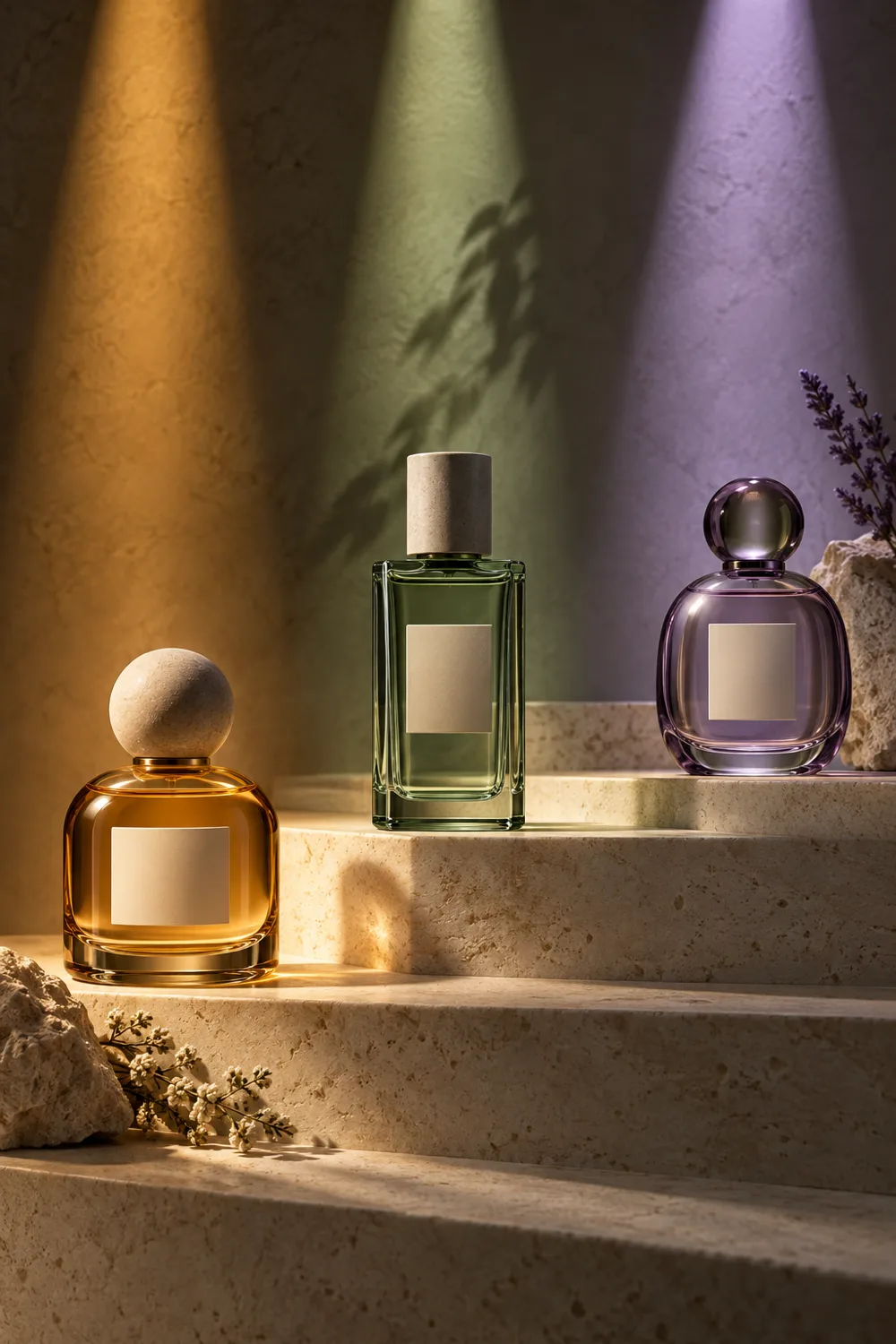
- One versatile daily-wear scent you can put on without thinking
- One distinct scent for a different context — evenings, colder months, or a more formal setting
- One lighter, cheaper option for gym, travel, or anywhere a bold scent isn’t welcome
- Nothing else, until you’ve lived with these three long enough to know what’s missing
That’s the whole starting framework. Three bottles, three clear jobs, no overlap. It’s a deliberately small target, and that’s the point — a capsule wardrobe works because every piece has a reason to exist, not because it covers every possible scenario from day one.
Why three, and not one or ten
One fragrance covers you completely only if your life has zero variation in climate, setting, and mood — which almost nobody’s does. Ten fragrances, bought early, usually means half of them go untouched because they were chosen for a version of your life you don’t have yet. Three is enough to cover the real variation most people encounter (daily default, a dressier or more intense context, and a stripped-down option for scent-sensitive settings) without turning into an expensive collection built on guesswork.
Scent one: the daily-wear default
This is the fragrance you reach for without deliberating — for a normal workday, running errands, most of an ordinary week. It should be:
- Moderate in strength. Noticeable up close, not filling a room. This is the piece you’ll wear most often, so it needs to be sustainable in shared spaces.
- Broadly liked, not polarizing. Save the unusual, conversation-starting scent for later. This slot is about reliability.
- A family you already know you enjoy. If you gravitate toward citrus or clean musks in soaps and candles, start there instead of guessing at something entirely new for the piece you’ll wear most.
Concentration-wise, an EDT usually fits this role well — present but not overwhelming across a full day. Our guide on where and how to apply fragrance covers how concentration and placement interact if you’re unsure which strength to start with.
Scent two: the context switch
This piece exists to be different from scent one in a way that matches a real, recurring part of your life — not a hypothetical. Common directions:
| If scent one is… | A good contrast for scent two |
|---|---|
| Light and citrus | Something warmer — amber, spice, or a soft gourmand for evenings or colder months |
| Clean and musky | Something with more presence — a woody or incense-leaning scent for more formal settings |
| Fresh and aquatic | Something richer — a floral or oriental for occasions that call for more depth |
The goal isn’t novelty for its own sake — it’s covering a meaningfully different context so you’re not wearing a summer-weight scent to a winter evening event, or a heavy evening scent to an ordinary Tuesday.
Scent three: the low-commitment option
This slot has a different job entirely: somewhere to be light, inexpensive, and unobtrusive. A gym bag, a scent-sensitive workplace, air travel — situations where a bold fragrance is actively the wrong choice. This is also the slot where it’s fine to spend the least, since strength and complexity aren’t what it’s optimizing for. A simple, clean, inoffensive EDT works better here than anything you’d call a “statement scent.”
What to deliberately leave out at this stage
- A niche “collector’s” bottle. Interesting, but not a beginner-capsule priority — see our breakdown of what separates niche from designer before spending there.
- A second scent in the same family as one you already own. Duplication, not expansion — resist it until the original three feel fully covered.
- Anything bought purely because it was trending. Trend-driven purchases are the single most common source of the “untouched bottle” problem in a fragrance collection.
Building the capsule without overspending
Sample sizes and discovery sets are worth using heavily at this stage, since committing to three full bottles before testing any of them on your own skin is a real gamble. See our full guide on building a fragrance wardrobe without overspending for the sampling and budgeting framework in more depth — the short version is: sample first, commit to a full bottle only once you’ve worn something for a few real days and still want more.
How long to live with three before adding a fourth
A reasonable rule: wait a full season before considering a fourth bottle, and only add it to fill a role the original three don’t cover — not because a new release caught your attention. If, after a season, all three are still getting regular use and none feels redundant, that’s a sign the framework is working and a fourth addition, not a replacement, makes sense.
A worked example
Someone building a first capsule might land on: a light citrus-aromatic EDT for daily wear, a warm amber-vanilla EDP for evenings and fall/winter, and an inexpensive clean-musk EDT for the gym and travel. Three distinct jobs, minimal overlap, and a total cost far below buying five or six bottles up front and hoping most of them earn their place. Once layering starts to feel interesting, this same trio also gives you three distinctly different starting points to combine, instead of three near-identical bottles that layer into more of the same thing.
Splitting a budget across the three slots
Because the three scents have different jobs, they don’t need equal budgets — and spreading money evenly across all three is often the wrong instinct. A workable default split: the largest share toward scent one, since it’s worn most often and cost-per-wear favors spending more there; a moderate share toward scent two, since it’s worn less frequently but still regularly; and the smallest share toward scent three, since its whole job is being cheap and replaceable. A rough 45/35/20 split of a total fragrance budget is a reasonable starting point, though the exact numbers matter less than the underlying logic: spend in proportion to how often something will leave the shelf, not evenly across three bottles as though they’re interchangeable.
This also means it’s fine, and often smart, to buy a notably nicer bottle for scent one even on a limited budget, and compensate by keeping scent three inexpensive instead of splitting the total evenly and ending up with three mediocre bottles instead of one excellent one and two adequate ones.
Signs the framework needs adjusting for you specifically
Not every life fits the three-slot template cleanly, and it’s worth checking in after a season instead of forcing the structure indefinitely. A few signs it needs tweaking: if scent three never gets used because you don’t encounter scent-sensitive situations often, that slot can shrink or disappear in favor of a second context-specific scent instead. If scent two gets worn almost as often as scent one, the “daily vs. occasional” split isn’t matching your real week, and it may make more sense to think of them as two co-equal defaults, not a primary and a secondary. The framework is a starting point for organizing a decision, not a rule to follow past the point it stops being useful.
Common beginner mistakes with this framework
- Choosing three scents in the same family. Defeats the purpose — the framework is about covering real variation, not building a themed set.
- Skipping scent three because it feels like the “boring” slot. It’s the one that prevents overspraying complaints at work or on a flight — worth taking seriously even though it’s the least exciting purchase.
- Buying all three at once, full price, with no sampling. A single miscalculated purchase in a three-bottle capsule is a bigger loss proportionally than the same mistake in a large collection.
Labeling the bottles so the system actually holds
A small, practical habit that keeps a capsule wardrobe from quietly drifting: physically note what each bottle’s job is, even if it’s just a sticky note inside a drawer or a note in your phone. “Scent one: daily” sounds unnecessary when you’ve just built the system, but six months later, with a few extra bottles that crept in as gifts or impulse buys, it’s easy to lose track of which one was supposed to be doing which job. Revisiting that note occasionally is a quick way to catch when a new purchase has quietly taken over a role without you deciding it should.
Quick answers
Can the three scents overlap a little? A shared note here and there is fine — total overlap (three versions of the same idea) defeats the point.
Is three a hard limit forever? No — it’s a starting structure, not a ceiling. Most people naturally expand past three over time; the framework just prevents an unfocused first purchase.
What if my lifestyle only has one real context, not three? Then two scents (a daily default and a low-commitment option) may be enough on its own — don’t force a third role that doesn’t correspond to anything in your actual week.
The value of starting small and structured isn’t about restriction for its own sake — it’s that three deliberately chosen bottles with distinct jobs will get worn far more often, and regretted far less, than a larger collection assembled without a plan.