The front door opens, cold air rushes in, and everyone starts peeling off coats in the entryway — that first ten minutes of a holiday gathering is a small chaos of wool, wet boots, and warming skin, and it’s exactly the moment a cold-weather scent routine either works or doesn’t. Cold air holds fragrance close to the body; the warmth of a crowded room then releases it all at once. Getting this season right is less about picking one “winter perfume” and more about building a short, deliberate routine around how the cold-to-warm transition behaves.
Why winter rewards layering more than any other season
Cold, dry air slows down how fast fragrance evaporates off skin — notes that would announce themselves in minutes during summer heat can take much longer to unfold in a cold entryway. That slower release is exactly why layering works so well in winter specifically: a scented lotion or oil applied underneath a spray perfume has time to develop gradually as your skin warms up indoors, instead of blasting out all at once the way it might in July. Our full guide on how scent layering works covers the mechanics in more depth if this is new territory.
Building the routine, step by step
- Start with an unscented or matching-scent moisturizer. Dry winter skin holds fragrance less evenly than well-moisturized skin, so this step isn’t optional the way it might feel in summer.
- Apply a scented body product as your base, if you’re layering. A vanilla or amber body lotion under a spicier perfume gives the composition a warm foundation that holds up under a coat all day.
- Spray the perfume itself at pulse points, then let it sit before dressing. Giving it a few minutes before pulling on layers of wool and coat keeps the scent from getting smothered before it’s had a chance to settle.
- Reassess once you’re indoors and warm. A scent that felt light in a cold car can bloom considerably once you’ve been in a heated room for twenty minutes — this is the moment to judge whether you’ve over- or under-applied, not the moment you first sprayed.
Which families hold up under a coat
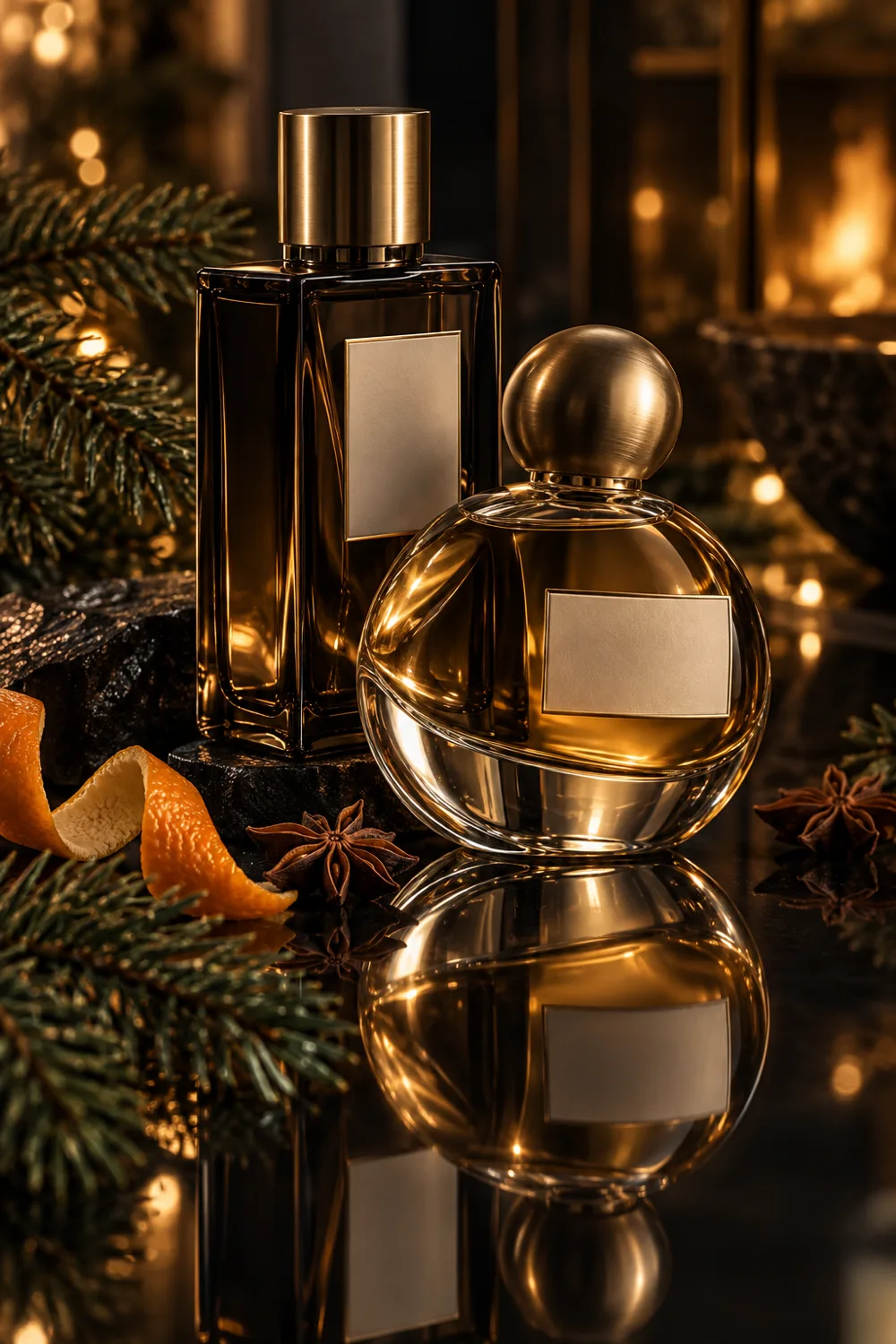
Not every fragrance family is built for this. Bright citrus and light aquatic scents, which read beautifully in warm weather, tend to get lost under heavy winter layers and cold-to-warm transitions — they evaporate too readily to survive being trapped under wool for hours. Ambers, warm spices (cinnamon, clove, cardamom), vanilla and other gourmand notes, and deeper woods are built for exactly this scenario: their heavier molecules evaporate slowly regardless of temperature, so they’re still present and recognizable hours later, indoors, after a coat has been on and off several times.
A seasonal layering combination to try
A cardamom-and-amber eau de parfum sprayed over an unscented or lightly vanilla-scented lotion base is a reliable holiday-gathering combination: the lotion keeps skin from drying out under repeated coat removal and central heating, and the spice-amber top holds its shape from a cold car to a warm room without disappearing.
Building a small holiday-specific layering set
You don’t need a large collection to make this work — an effective winter layering set can be built from as few as three pieces: an unscented or lightly-scented moisturizer as the base, one scented body product (a lotion, oil, or body wash) in a warm family, and one perfume that shares or complements that family. The goal isn’t variety at this stage, it’s making sure each layer reinforces the others instead of fighting for attention. A vanilla-amber body lotion under a spiced amber perfume reads as one cohesive scent; a citrus body wash under a heavy oud perfume reads as two unrelated things competing, which is a common reason layering attempts fail even when each individual product is good on its own.
If you’re shopping specifically to build this set instead of working with what you already own, prioritize the body-product layer first — an unscented or complementary lotion does more for how the whole routine holds up over a long day than an additional perfume bottle would, and it’s typically the cheaper piece to add.
How this differs from a normal-weather layering routine
Layering works year-round, but winter changes the math in a specific way: cold, dry skin and air slow down release across the board, which means you have more room to build a multi-step routine without it becoming overwhelming the way the same three-step process might in summer heat. A body lotion, a perfume, and a light hair mist stacked together in July can turn into a wall of scent within the first hour; the same three-step stack in a cold, dry winter room has much more time to unfold gradually, layer by layer, before all three are fully present at once. This is part of why winter is often recommended as the easiest season to start experimenting with layering if you’re new to it — the slower pacing forgives small mistakes that would be more noticeable in warmer months.
Adjusting for different kinds of winter gatherings
| Setting | Adjustment |
|---|---|
| A small, quiet family dinner | Keep the full three-step routine, but apply lighter — a smaller, more intimate room needs less projection than a packed party |
| A large, crowded holiday party | The routine can support a slightly heavier application, since body heat from a full room and general noise/movement both work against a scent’s presence |
| An outdoor winter event (a tree lighting, an outdoor market) | Apply normally before leaving — cold outdoor air will slow release further, so don’t compensate by over-applying |
| A long day with multiple stops (family visit, then a party) | A travel-size version of your perfume for a light midday top-up, layered over the same body-product base from the morning |
Common mistakes this season specifically invites
- Overcompensating for cold weather with too much product. Cold skin releases scent more slowly, which tempts people to spray heavier — but once you’re indoors and warm, that same amount can read as overwhelming. Apply a normal amount and let indoor warmth do the rest.
- Forgetting scarves and coat collars hold scent too. A light spritz on a scarf (not directly against skin) can extend a scent’s presence through a long day of coats coming on and off, though test on an inconspicuous corner first since not every fabric handles this well.
- Ignoring how a scent smells in a warm, crowded room versus a quiet house. Body heat from a full room of people changes how projection works — what’s perfect for a quiet dinner can read differently at a packed party.
Building this into your broader wardrobe
A dedicated cold-weather scent doesn’t need to be a separate purchase if your existing collection already leans warm — see our fall/winter fragrance rotation guide for a fuller seasonal wardrobe approach, and our notes on building a fragrance wardrobe without overspending if you’re starting from close to nothing this season. The goal isn’t a new bottle for every holiday party — it’s a short, repeatable routine that holds up through coats, cars, and crowded rooms.
If you’re hosting instead of attending
Hosting changes the calculation slightly: you’ll be moving between a warm kitchen, a crowded living room, and possibly a cold porch or entryway repeatedly over the course of an evening, greeting people at the door in a burst of cold air each time. A host’s routine benefits from erring toward the lighter, more layered-but-subtle end of the range described above, since you’ll be experiencing more temperature swings than any single guest will, and reapplying isn’t practical mid-event. Applying the full routine once, well before guests arrive, and trusting the base layer to carry the scent through the evening’s temperature changes works better than trying to manage it in real time while also hosting.
Quick answers
Can I use the same layering set for both a formal party and a casual family visit? Yes — the base routine stays the same; adjust only the number of sprays, lighter for a small gathering, slightly more for a large crowded one.
Does layering under a coat waste product, since it’s covered up anyway? No — a coat traps warmth against skin, which if anything helps the scent build and hold, instead of dissipating into open air the way it would outdoors without a coat.
What if I don’t own any scented body products yet? Start with just the perfume applied to pulse points; a body-product base is worth adding over time, but a well-chosen single fragrance still works fine as a cold-weather routine on its own.
The takeaway
Winter gatherings put fragrance through more transitions in one evening than almost any other occasion — cold outside, warm inside, layers on, layers off, a crowded room, then back out into the cold. Building a short, deliberate routine around a warm-leaning base handles that better than any single spray ever could — and once it’s set up, it’s a routine you can repeat at every gathering this season without rethinking it each time.