Does scented lotion need to match your perfume? Short answer: no, not in the sense of needing the exact same product line or the identical named scent. But that’s not quite the same as “it doesn’t matter at all” — the two do interact, and a mismatch between lotion and perfume families is a common, fixable source of a fragrance smelling “off” for no obvious reason. This piece is specifically about that matching question — for the broader routine (body wash, deodorant, hair product, and how they all interact with perfume), see our fuller guide on layering perfume with body products.
What “match” means here
Nobody needs a lotion from the same product line as their perfume, and there’s no rule requiring an identical scent name on both labels. What matters is family-level compatibility: does the lotion’s dominant character (sweet, fresh, warm, floral) sit comfortably alongside the perfume’s, or does it pull in a conflicting direction? A citrus perfume and a citrus lotion aren’t “matching” in any strict sense, but they’re compatible. A citrus perfume and a heavy vanilla-coconut lotion aren’t matching either, and they’re also not compatible — that’s the distinction that determines whether it works.
Three honest options, not one right answer
Option 1: Go unscented
The lowest-risk choice. An unscented or fragrance-free lotion never competes with the perfume, full stop. This is the right default if you’re not sure what to pick or you’ve been burned by a clash before.
Option 2: Match the family loosely
Choose a lotion in the same general direction as your usual perfume — light and citrus-clean if that’s your perfume’s lane, warm and vanilla if that’s yours. This can subtly extend and reinforce the fragrance instead of just staying out of its way.
Option 3: Pick a same-brand companion product
If the perfume brand sells a matching body lotion or cream, it’s usually formulated specifically to echo the fragrance without overpowering it — the lowest-effort version of option 2, since the compatibility work has already been done for you.
When mismatched scent causes a real problem
Not every mismatch is noticeable. A very light, quickly-fading lotion scent layered under a much stronger perfume often just gets overridden entirely — the perfume wins by concentration alone, and the lotion’s scent never gets the chance to clash. The cases where it does become a real problem tend to share a pattern:
- Both products are similarly strong. Two loud, competing scents at comparable strength is the classic clash scenario.
- The families pull in opposite directions. Sweet-gourmand lotion under a sharp, green, aromatic perfume (or the reverse) tends to read as confused, not complex.
- You apply them back-to-back with no gap. Both products’ top notes are loudest in the first several minutes — stacking that moment doubles the collision instead of letting one settle before the other arrives.
A simple decision guide
| Your situation | Best move |
|---|---|
| You don’t know your lotion’s exact scent family | Go unscented — removes the guesswork entirely |
| You want to build a coordinated routine | Match loosely by family, or use a same-brand companion product |
| You’ve noticed a specific clash before | Identify which product is louder and consider swapping it for unscented first |
| You’re testing a brand-new perfume | Use unscented products until you know how it wears, then decide if a matched lotion adds anything |
Does an unscented lotion make the perfume “worse”?
No — if anything, an unscented base is the safest way to let a perfume show its true character without any outside interference. The idea that scented lotion is somehow necessary to “complete” a fragrance is more marketing convention than fact. Plenty of well-put-together fragrance routines skip scented lotion entirely and rely on the perfume alone to carry the whole effect.
What “matching” looks like across the main scent families
For anyone who wants to coordinate deliberately instead of defaulting to unscented, here’s a practical breakdown by family. This assumes you already know your perfume’s dominant family — see our guide to the 7 main fragrance families if you’re not sure which one yours falls into.
| Perfume family | Lotion direction that coordinates well | Direction to avoid |
|---|---|---|
| Citrus / fresh | Light, green, or unscented | Heavy vanilla, coconut, or deep musk — too dense for a light perfume to sit on top of |
| Floral | Soft, powdery, or unscented | Anything strongly fruity or gourmand — competes with delicate floral top notes |
| Woody / earthy | Unscented, or a matching cedar/sandalwood-adjacent product if available | Bright citrus — the contrast can feel jarring instead of complementary |
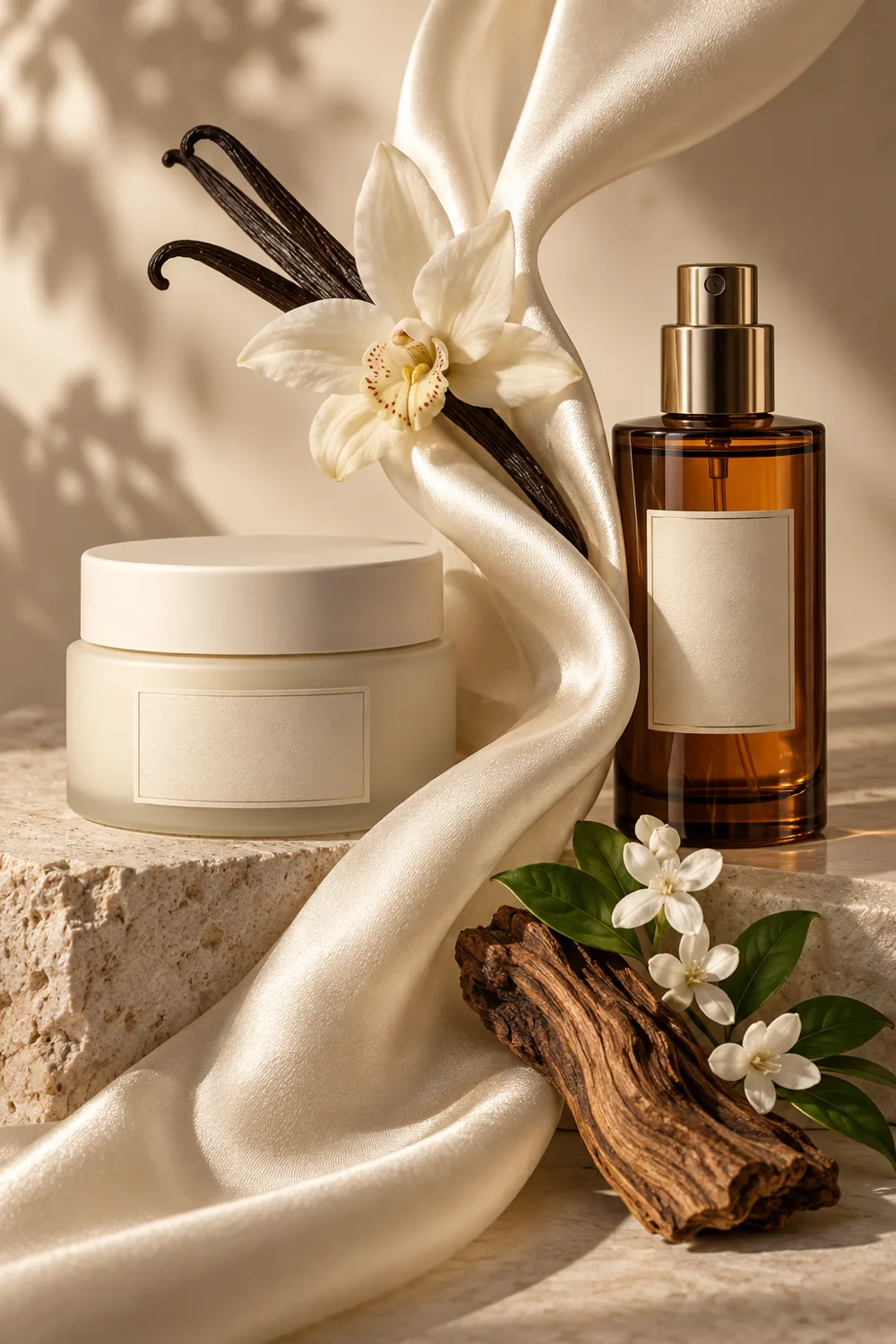
| Oriental / warm gourmand | Vanilla, amber, or unscented | Aquatic or marine-scented lotion — the temperature mismatch reads as confused |
None of these pairings are strict rules — fragrance is personal, and plenty of people enjoy combinations that fall outside this table on purpose. It’s a starting point for anyone who wants fewer surprises, not a ceiling on experimentation.
Timing matters as much as the product choice
Even a well-matched lotion and perfume can clash if applied at the same moment, because both products’ loudest, most concentrated notes are in the first several minutes after application. Giving the lotion even ten to fifteen minutes to settle before applying perfume gives its top notes room to fade, so the perfume isn’t opening into a fresh wave of competing scent. This single timing adjustment fixes a surprising number of “my lotion and perfume don’t get along” complaints without requiring either product to change at all.
The order matters too, and it’s worth stating plainly: lotion goes on first, perfume goes on after, with very few exceptions. Applying perfume and then layering lotion on top disrupts the perfume before it’s had any chance to develop, and can visibly dilute or smear a fresh application — a worse outcome than any scent-family mismatch.
A worked example
Someone wearing a warm amber-vanilla perfume asks whether their existing “cucumber melon” lotion is a problem. It is, structurally — cucumber-melon is a fresh, green, watery family, close to the opposite end of the spectrum from warm amber-vanilla. Two workable fixes: switch to an unscented lotion (simplest), or, if they specifically want a coordinated routine, look for a vanilla or warm-musk lotion instead and apply it at least fifteen minutes before the perfume so its own top notes have faded before the perfume goes on.
What if you already own a lotion that doesn’t match anything you wear?
Before writing off a lotion entirely, it’s worth checking whether the clash is real or assumed. Apply the lotion alone and wait fifteen minutes, then smell it again — many lotion scents fade dramatically once they’ve had time to settle, and what seemed like a strong, competing note at application might be nearly gone by the time perfume goes on top. If it’s still noticeable after that wait, the mismatch is real and one of the three options above applies. If it’s faded to something faint, it may simply not be worth worrying about, regardless of which family it technically belongs to.
A lotion that clashes with one perfume in a wardrobe doesn’t need to be thrown out — it just means saving it for days when you’re wearing something from a compatible family, or reserving it for use on days you’re not wearing perfume at all. Nothing about mismatched scent products is a permanent problem; it’s a pairing decision that can change from one day to the next depending on what else is going on your skin.
Quick answers
Do I need to buy a “matching” lotion for every perfume I own? No — that gets expensive and unnecessary fast. Unscented lotion works safely under any perfume, which is why it’s the default recommendation here.
Is body butter different from lotion for this purpose? Not meaningfully — the same family-compatibility logic applies regardless of the product’s texture or thickness. A heavier, richer product just tends to have a stronger scent presence, which raises the stakes on getting the family right.
What about lotion with SPF — does sunscreen change the picture? Many sunscreens carry their own distinct chemical scent that’s harder to mask or coordinate around. If daily SPF is part of your routine, prioritize finding a fragrance-free SPF formula over trying to match perfume to a sunscreen scent, which is a much harder pairing to solve for.
The honest answer sits between the two extremes people usually expect: lotion and perfume don’t need to be the same product to work together, but they aren’t completely independent of each other either. Pay attention to family and strength, default to unscented when in doubt, and the question mostly answers itself. It’s a small decision compared to choosing the perfume itself, but it’s one of the few remaining variables in a routine that’s easy to fix once you know what to look for — and it costs nothing to check the next time you’re standing in front of your own shelf.
If you’re building a routine around one specific perfume long-term, it’s worth doing a one-time check: wear the perfume alone for a day, then wear it with your usual lotion and body wash the next, and pay attention to whether anything changes. Most people never notice a real conflict, but if you do, it’s far easier to catch and fix in a low-stakes comparison than to keep wondering why a favorite fragrance sometimes seems to perform differently for no obvious reason.