You’re not going to want your usual evening fragrance for a workout, and it’s not just about strength — sweat, heat, and hours of physical movement change how a scent behaves in ways a normal day never tests. A composition that’s well-balanced sitting at a desk can turn into something unrecognizable an hour into a hard workout, and not always in a good way.
What working out does to fragrance on skin
Two things happen at once during exercise: body temperature rises, which speeds up how fast fragrance molecules release from skin, and sweat introduces an entirely new chemical element into the mix. Sweat itself has its own scent profile, and it interacts unpredictably with whatever fragrance is already on your skin — sometimes muting it, sometimes clashing with it, sometimes intensifying certain notes in a way the original composition never intended. Heavy, complex fragrances built around subtle interplay between many notes tend to fall apart under these conditions faster than simple, clean compositions do.
What tends to hold up
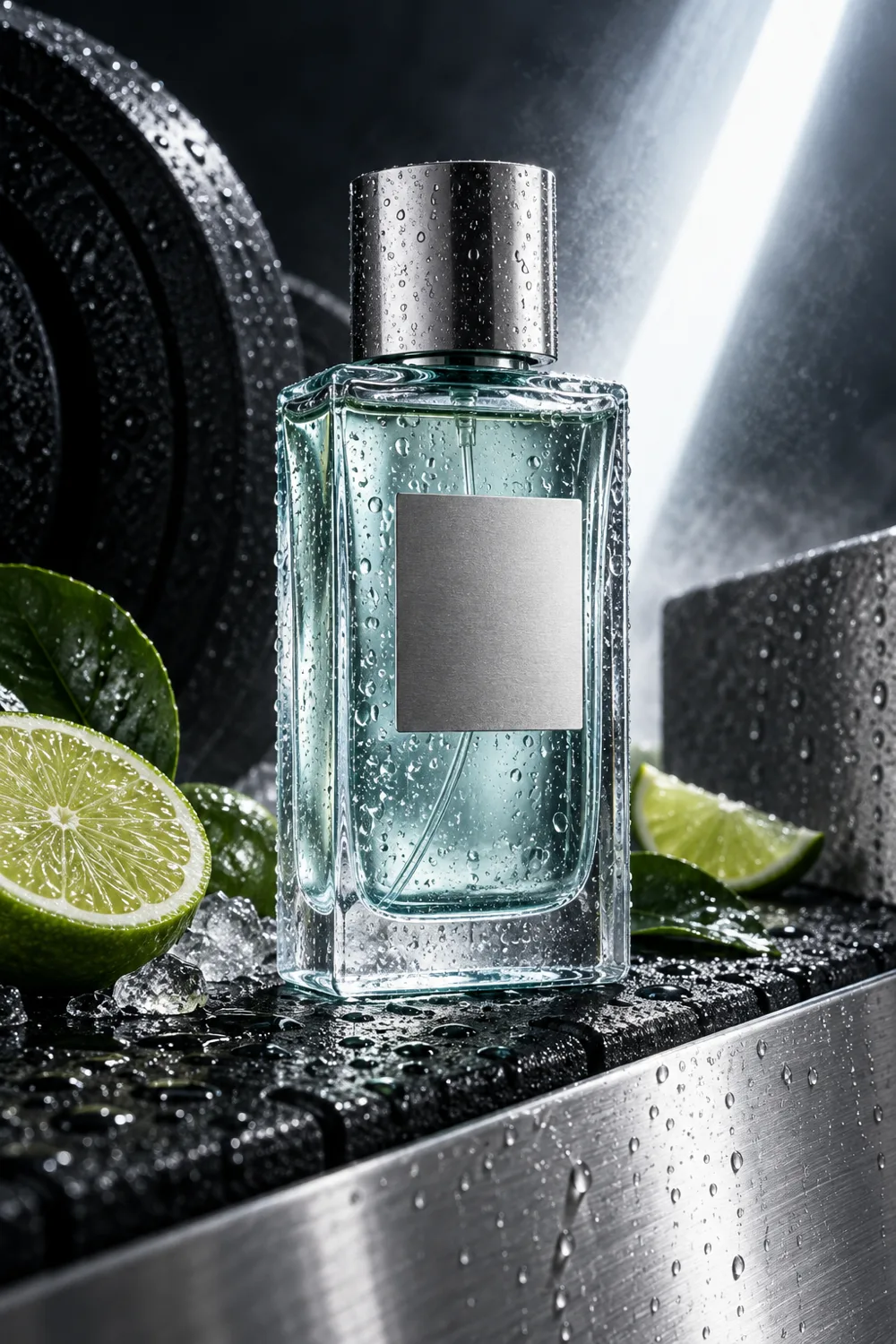
- Clean, simple citrus or aquatic scents — these are built around a small number of bright, straightforward notes, which gives sweat less to interact badly with than a dense, multi-layered composition.
- Light, low-concentration formulas — an EDT or a body mist applied lightly gives you a clean-scent effect without much for heat and sweat to amplify into something overwhelming.
- Ginger, mint, and other sharp, cooling notes — these tend to read as fresh instead of clashing even as body temperature climbs, and pair reasonably well with the natural scent of a hard workout instead of fighting it.
What to skip for a workout specifically
| Skip for the gym | Why |
|---|---|
| Heavy gourmands (vanilla, caramel, praline-forward) | Sweet notes can turn cloying or sour-adjacent once mixed with sweat and heat |
| Dense oud or heavy amber compositions | Built for slow, controlled release — heat and exertion force them to release all at once, unbalancing the scent |
| Anything you’re not willing to have permanently associated with a gym bag | Fragrance and memory are tightly linked — see our note below |
Why deodorant and fragrance are doing different jobs here
It’s worth separating two things that get lumped together: odor control and fragrance. An antiperspirant or deodorant is built specifically to manage sweat production and the bacteria that cause body odor — that’s its actual job, and it’s formulated to hold up under exactly the heat and moisture a workout produces. A fragrance, even a light one, isn’t built for that job at all; it’s layered on top and has no odor-control function of its own. Treating a splash of cologne as a substitute for deodorant is a common mistake — it doesn’t address the underlying cause of workout odor, and worse, it can combine with sweat in ways that smell more noticeable than sweat alone would.
Different workout types, different considerations
| Workout type | What matters most |
|---|---|
| High-intensity cardio, heavy sweating | Skip fragrance, rely on antiperspirant/deodorant alone — sweat volume makes fragrance interaction unpredictable |
| Weightlifting, moderate exertion | A very light, clean scent can work if you tend to sweat less during this type of session |
| Yoga, pilates, low-intensity classes | Close proximity to others in a shared room makes a very light or no-fragrance approach more considerate |
| Outdoor activity (running, hiking) | Open air disperses both sweat smell and any fragrance faster, giving more room for a light application than an indoor gym would |
Shared spaces change the calculation too
A crowded gym floor, a small group fitness class, or a shared locker room all put you in close, often poorly ventilated proximity with other people who are also sweating and breathing hard — a setting where a strong fragrance is more likely to bother someone than in almost any other context. This is a separate consideration from how the fragrance interacts with your own sweat chemistry: even a fragrance that would hold up fine on your skin under exertion can be an inconsiderate choice in a packed spin class or a small yoga studio, simply because of how close everyone is breathing in a confined space. When in doubt in a shared indoor fitness setting, defaulting to unscented is the more considerate choice, independent of how the scent itself would perform.
A note on pre-workout supplements and their own smells
Many pre-workout supplements and protein products have their own distinct smell, which can interact with any fragrance you’re wearing in unpredictable ways — another reason a workout is a poor testing ground for how a fragrance performs generally. If you’re trying to evaluate a new fragrance honestly, a gym session (with its sweat, supplement smells, and shared-space considerations) is about the worst controlled environment you could choose; save real fragrance evaluation for a normal day.
Or consider skipping fragrance entirely
For a hard, sweat-heavy workout, many people are better served skipping fragrance altogether and relying on a clean, unscented antiperspirant instead. There’s nothing wrong with this — a gym is one of the few settings where “no fragrance” is often the most functional choice, not a compromise. If you do want something, an unscented or very lightly scented deodorant is a lower-risk starting point than a full fragrance application before a workout.
Post-workout: a second, separate consideration
After showering and before heading elsewhere (work, errands, socializing), a normal application is fine — the sweat-interaction problem only applies while you’re actively exercising and producing sweat, not afterward on clean skin. This is a reasonable moment to apply your usual routine, including any layering — see our guide on how scent layering works if you want to build a post-gym routine around a scented body wash plus a light perfume layer.
One more consideration: scent memory
Because scent and memory are tied together so tightly, a fragrance worn consistently during hard workouts can end up associated with that specific context — not necessarily a bad thing if that’s the association you want, but worth knowing before you commit your favorite everyday bottle to gym duty exclusively. Our piece on why scents trigger strong memories covers the mechanism behind this if you want the fuller explanation.
Building a gym-specific routine if you want one
- Shower and use a clean, functional deodorant or antiperspirant first. This is the piece doing the actual work — don’t treat it as optional or secondary to any fragrance step.
- Decide whether a pre-workout scent is worth it at all. For most hard workouts, the honest answer is no — see the framework above for when it might make sense.
- If you do want something, choose a small, dedicated bottle you don’t mind “using up” on gym duty. This keeps your main fragrance collection reserved for settings where it can be appreciated properly, instead of wasted on conditions built to distort it.
- Apply sparingly — one spray, not your normal amount. The goal pre-workout is barely-there, not a full application that will only get overwhelmed by sweat within the first twenty minutes anyway.
What about scented workout clothes and gear?
Scented laundry detergent and fabric softener are a separate, often-overlooked source of fragrance at the gym — a strongly scented gym bag or set of workout clothes can be doing as much “scent work” as anything you’d spray directly on skin, and it interacts with sweat over the course of a workout in the same unpredictable way. If you’re trying to manage fragrance carefully for gym settings specifically, an unscented or lightly scented detergent for workout gear is worth considering alongside anything you apply to skin, since a heavily scented shirt won’t stop smelling once you start sweating into it.
A simple gym-bag approach
If you want one low-effort system: keep a small, cheap, simple citrus or aquatic body mist specifically for pre-workout (or skip it and use unscented deodorant only), then keep your normal fragrance routine — including anything from your regular rotation — for after you’ve showered and changed. This avoids wasting a fragrance you like on conditions it wasn’t built for, while still letting you smell intentional before and after.
Quick answers
Is it fine to wear my regular perfume to a light workout, like a slow walk or a casual yoga session? Yes — low-intensity activity with minimal sweat doesn’t trigger the same interaction problems as a hard cardio session, so your normal light application is usually fine, though it’s still worth going a little lighter than your evening amount out of consideration for anyone sharing the room with you.
Will wearing fragrance to the gym ruin the bottle or make it wear out faster? No — using a fragrance doesn’t affect how it performs in future wears. The only real cost is committing that specific bottle to a gym-duty association if you wear it there consistently.
What if my gym has a strict no-fragrance policy? Some gyms, especially ones with scent-sensitive members, do enforce this — follow it without exception, and use it as a simple reason to default to unscented deodorant only during any workout there — it also spares you from having to make the judgment call yourself every time.