- Any perfume bottle over 3.4 oz (100 ml) has to go in checked luggage — full-size bottles almost never qualify for a carry-on.
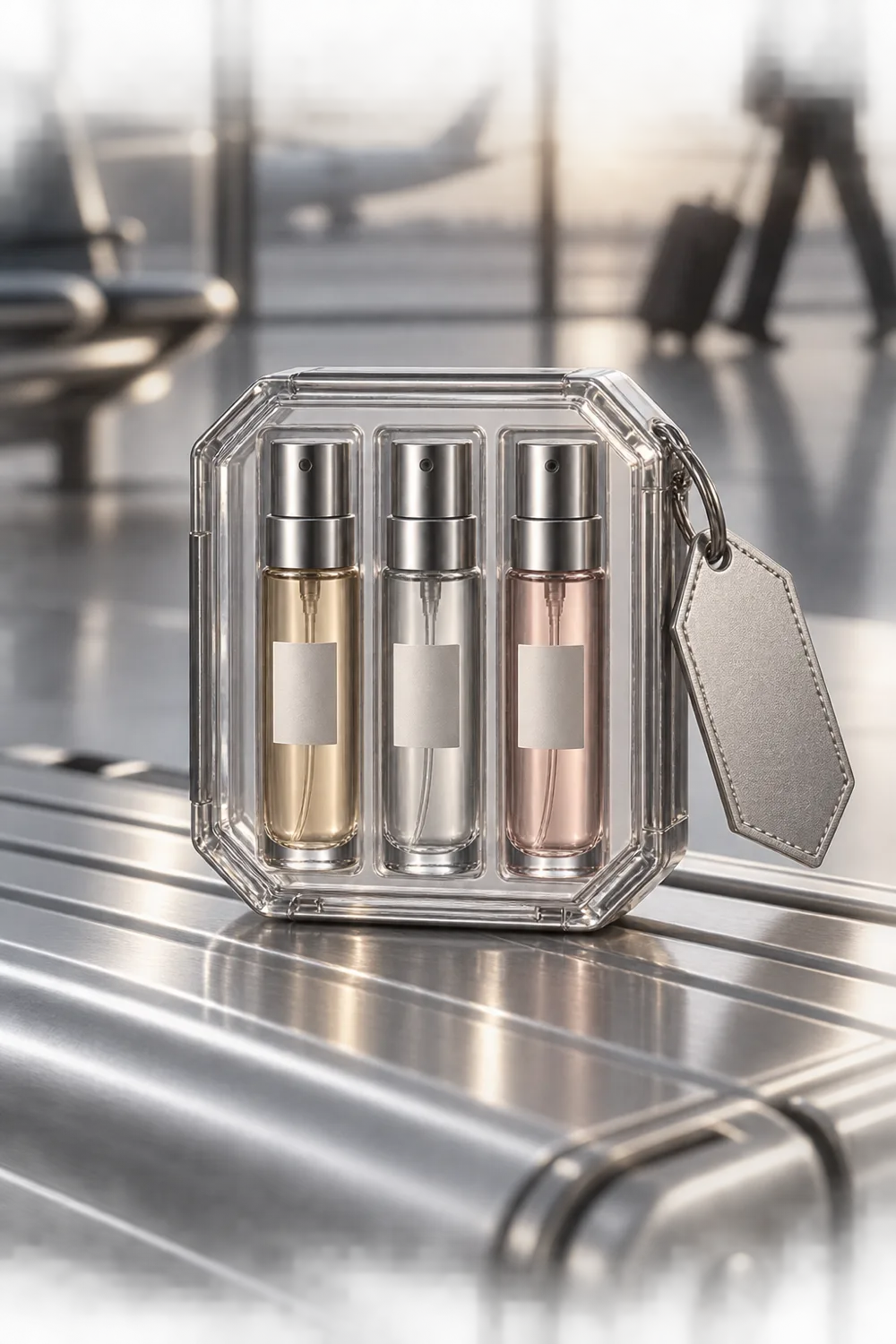
- Bottles at or under 3.4 oz (100 ml) each go in your one quart-sized liquids bag, alongside every other liquid, gel, and aerosol you’re carrying on.
- Solid fragrance (balms, waxes) isn’t covered by the liquids rule at all — it can go in your bag without size restrictions.
- Pack a spare travel atomizer instead of checking your only bottle, in case checked luggage is delayed or lost.
That’s the short version for getting through security without a confiscated bottle. Here’s the reasoning and a few details worth knowing before you pack.
The actual rule, verified
The TSA’s current liquids rule — commonly called the 3-1-1 rule — sets two limits at once. Per the TSA’s own published guidance, each container must hold “3.4 ounces (100 milliliters) or less,” and everything combined has to fit in “a quart-sized bag of liquids, aerosols, gels, creams and pastes.” Anything in a container larger than 3.4 oz, even if it’s only partially full, gets flagged at screening and either checked, surrendered, or requires you to step out of line to sort it — none of which you want to deal with at security.
This applies to perfume the same way it applies to any other liquid: a full-size 100 ml bottle is right at the legal limit, and many standard retail bottles (3.4 oz is a common perfume bottle size for exactly this reason) are sized deliberately to qualify.
Travel-size and decant options
| Option | Pros | Cons |
|---|---|---|
| Brand travel atomizer (often 5-10 ml) | Purpose-built for refilling, durable, reliable seal | Not included with every bottle — sometimes a separate purchase |
| Decant into a small refillable atomizer | Cheap, works for any fragrance, very compact | Requires transferring liquid yourself — do it over a sink |
| Buy a full 3.4 oz bottle specifically for travel | No decanting hassle, same product as home | Priciest option per trip if it’s not your main bottle |
| Solid fragrance balm | Not subject to the liquids rule at all | Fewer fragrance options available in solid form |
Packing it so it survives the trip
A few practical habits that prevent the two most common travel-fragrance failures — leaks and breakage:
- Wrap glass bottles in clothing, not just a pouch. A sock or a folded shirt gives real cushioning against the jostling checked and carry-on bags both take.
- Keep the bottle upright and avoid overfilling a decant atomizer. Air pressure changes during flight can cause a completely full container to leak slightly — leaving a small air gap helps.
- Double-bag anything you’re worried about. A small zip bag inside your liquids bag contains a leak before it reaches clothes or electronics.
International travel adds another layer
The 3.4 oz / 100 ml figure is the US TSA standard; many other countries use an equivalent 100 ml limit for carry-on liquids, but rules can vary by country and airport, and connecting through multiple countries can mean your liquids get re-screened under a different jurisdiction’s rules. If you’re on a multi-leg international itinerary, checking the departure airport’s specific liquids policy before you fly is worth the two minutes it takes.
Checked luggage has its own considerations
Moving a full-size bottle to checked luggage solves the carry-on size problem, but introduces different risks worth planning around. Checked bags get handled roughly, sit in unpressurized or variably pressurized cargo holds, and can experience real temperature swings on the tarmac — all conditions that are harder on both the bottle itself and the fragrance inside it than a climate-controlled cabin. Wrapping the bottle securely (inside clothing, in the center of the bag, not against a hard edge) reduces breakage risk, and if you’re checking a fragrance for a hot-climate trip, keep in mind that cargo holds on the tarmac before takeoff can reach temperatures well above what any fragrance was designed to tolerate for extended periods.
If a checked bottle does break in transit, most airlines have a claims process for damaged items, though a full-size fragrance bottle is a modest claim in the context of lost-luggage handling generally — worth knowing about, not worth over-relying on as a backup plan.
Duty-free purchases and connecting flights
Duty-free fragrance bought after security is generally exempt from the liquids rule for your current flight, since it’s sealed and purchased past the checkpoint — but this exemption can create a real problem on connecting itineraries. If your connection requires a re-screening (common on international layovers, or when switching between certain airlines or terminals), a duty-free bottle bought on the first leg may not clear the second security checkpoint unless it’s still in its original tamper-evident bag with the receipt visible. If your trip involves a connection with re-screening, it’s worth checking the specific connecting airport’s duty-free policy before assuming a duty-free purchase will sail through untouched.
A packing checklist for the fragrance-conscious traveler
- Confirm every liquid fragrance container is 3.4 oz / 100 ml or under before packing your carry-on.
- Fit all liquids into a single quart-sized bag alongside your other toiletries — don’t assume fragrance gets separate treatment.
- Wrap glass bottles in clothing for cushioning, whether carry-on or checked.
- Consider a solid fragrance balm for the simplest possible packing, with zero liquids-rule considerations.
- If checking a full-size bottle, pack it centrally in the bag, away from hard edges and corners.
- Check the specific rules for any connecting airport if your itinerary involves re-screening.
Building a travel-specific mini routine
Travel is also a reasonable moment to simplify instead of packing your full rotation — a single versatile scent that works across the different contexts a trip involves (daytime sightseeing, a dinner out, a long flight) beats trying to travel with several full-size bottles. If you’re building toward a smaller, more versatile collection generally, see our guide on building a fragrance wardrobe without overspending. And if you’re headed somewhere with a different climate than home, our piece on how weather and humidity change the way fragrance wears is worth a look before you decide what to pack.
Quick answers
Can I bring a full-size bottle if it’s mostly empty? No — the restriction is based on the container’s labeled size, not how much liquid is inside it.
Does solid perfume skip the liquids rule entirely? Yes — solids, waxes, and balms aren’t classified as liquids, gels, or aerosols, so the 3.4 oz limit doesn’t apply to them.
What if my atomizer isn’t clearly labeled with its size? Carry the original packaging if you’re unsure, or measure it yourself before you travel — screening officers go by the container’s actual capacity, and an unlabeled bottle that looks borderline can get extra scrutiny.
Do I need to declare fragrance separately from other liquids at security? No — it’s treated the same as any other liquid, gel, or aerosol in your bag, with no special declaration process of its own. Treat it exactly like a toiletry — pack it with your other liquids, keep it under the size limit, and it moves through screening the same way a bottle of shampoo or sunscreen does, and screening officers don’t need to know or care what specific fragrance is inside the bottle — to them, it’s simply liquid, sized and bagged correctly or not, exactly like everything else in the bin.
What TSA agents see at the checkpoint
Understanding what happens on the other side of the X-ray helps explain why certain packing habits matter more than others. Screening equipment flags containers by density and shape as much as by declared size, so a bottle that looks larger than the standard travel-size norm can draw a second look even if it’s technically compliant — an oddly shaped decant or a bottle without clear volume markings is more likely to get pulled for a manual check than a standard, clearly labeled travel atomizer. This isn’t a rule so much as a practical pattern: recognizable, clearly labeled containers tend to move through screening with less friction than unusual ones, independent of whether both are equally within the size limit.
A note on refillable atomizers specifically
Refillable atomizers are a popular way to bring a favorite fragrance without buying a dedicated travel size, but they come with a couple of practical caveats worth knowing before your first trip. First, decanting from a full-size bottle into a small atomizer is worth doing over a sink or a tray — spills happen more often than expected, especially with a dropper or a poorly fitting nozzle. Second, some atomizers use a squeeze-bulb or spray mechanism that can leak under the pressure changes of a flight if not sealed properly; testing a new atomizer with a few short flights’ worth of handling (tipping it, shaking it gently, leaving it in a bag overnight) before relying on it for real travel is a reasonable way to catch a bad seal before it ruins a shirt in your bag.
Source: TSA.gov, “Liquids Rule” (verified current at time of writing).