A brief history that explains most modern summer fragrance advice
The eau de cologne format — the lightest, most diluted concentration on the market — traces back to 1709, when Giovanni Maria Farina, an Italian perfumer working in Cologne, Germany, created the original formula. It started as an expensive luxury item used sparingly by European royalty, not an everyday splash. Over the following century, as the format spread and became more widely available, it evolved into exactly that: a light citrus-forward splash applied liberally as a refreshing body scent and even a mild antiseptic, prized for feeling cooling and clean, not heavy or dramatic. That later, more accessible version of the idea is still the template most “summer fragrance” advice quietly borrows from, even when nobody names the connection directly. Understanding that history explains why summer fragrance guides converge on similar advice: lighter, fresher, less concentrated — it’s not a modern trend, it’s a couple hundred years old.
Why summer heat changes the math
Heat speeds up evaporation directly — it’s basic chemistry, not a subjective seasonal preference. Fragrance is built from layers of molecules with different volatility; top notes are light and fast-evaporating even in mild weather, and summer heat pushes that process into overdrive across every layer, not just the top. A dense, heavy composition built for slow-evaporating winter air can turn overwhelming once that same evaporation happens two or three times faster, projecting harder and reading as far more intense than the perfumer likely intended for typical wear.
This is the entire logic behind “wear lighter fragrance in summer” — not fashion, not tradition for its own sake, but a direct response to how heat changes evaporation rate and therefore projection.
What works in the heat
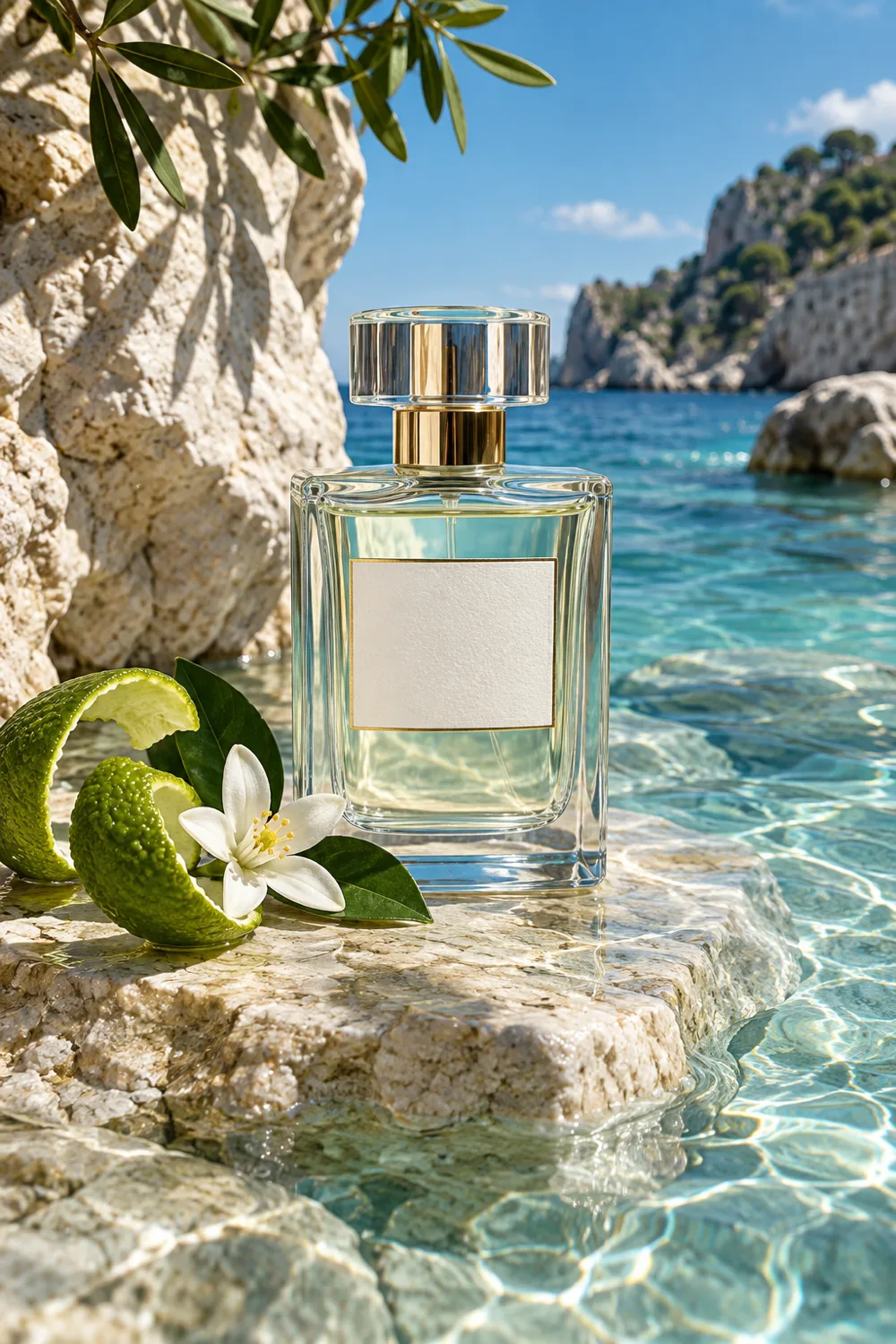
- Citrus and citrus-aromatic compositions — the closest living relative to that original eau de cologne idea, and still one of the most reliable warm-weather categories for a reason.
- Aquatic and marine notes — a more modern addition to the summer category, built to evoke water and freshness, and light enough to suit heat without adding to it.
- Light, green notes — cut grass, crushed stems, fresh herbs — read as clean and seasonally appropriate without any sweetness to turn cloying in heat.
- Sheer, “skin scent” musks — modern synthetic musks built to sit close to skin instead of projecting loudly, suited to heat where anything louder can feel like too much.
What tends to struggle
Heavy gourmands, dense ambers, and thick, syrupy sweet compositions are the most common summer casualties — not because they’re poorly made, but because heat pushes their already-rich character to project harder than most people want in close summer proximity to other people. This isn’t an absolute rule (a well-balanced, lighter gourmand can work in moderation), but it’s the pattern worth knowing before reaching for your favorite cold-weather bottle on a 95-degree day.
Concentration matters more in summer than any other season
| Concentration | Summer suitability | Why |
|---|---|---|
| Eau de cologne (EDC) | Excellent | Built for exactly this — light, low-commitment, easy to reapply |
| Eau de toilette (EDT) | Good | Light enough for most summer days, moderate longevity |
| Eau de parfum (EDP) | Situational | Works if the underlying composition is already light; heavier EDPs can overwhelm |
| Parfum / extrait | Use sparingly | Highest concentration means the strongest heat-amplified projection — apply less than you would in winter |
Choosing a lighter concentration is often a bigger lever than choosing a “lighter” fragrance family within a heavy concentration — the two variables interact, and concentration alone can be the difference between comfortable and overwhelming on the same bottle.
Application changes in summer too
Faster evaporation means shorter wear time, which changes the practical routine: apply a little more than you would in cooler weather to compensate, and keep a light rollerball or decant on hand for a midday refresh instead of trying to make one morning application carry an entire hot day. Our guide on making fragrance last all day covers this in more depth, and how weather and humidity change the way fragrance wears explains the underlying mechanism driving all of it.
Pulse points still matter in summer, but consider applying slightly less per point than you would in winter — the same warmth that helps continuous release in cold weather is already elevated by ambient heat, so a full winter-strength application at a pulse point can read as more intense than intended.
Humidity adds a separate wrinkle
Humid summer heat behaves a little differently than dry summer heat. Both speed up evaporation, but humid air’s saturation can make a fragrance feel like it stays closer to the skin instead of projecting outward the way it might in dry heat — the practical result is a scent that can fade in perceived reach even while technically still present. This is one more reason the “skin scent” musk category above tends to suit humid climates particularly well: it’s already built to sit close, so it doesn’t fight against what humidity is already doing.
A minimal summer kit
- One reliable light daily fragrance — citrus, aquatic, or green, whichever suits your taste, in EDT or lighter.
- A travel-size or rollerball version of the same fragrance for a midday refresh without carrying a full bottle.
- An unscented moisturizer for pre-application skin prep — the same hydration benefit that helps year-round matters just as much in summer, even though heat makes it feel less necessary.
Coming from a heavier winter or spring rotation
If you’ve already built out a spring rotation with a lighter daily option and a slightly richer cool-morning bottle, summer is largely an extension of that same direction, pushed further: drop the cool-morning option entirely for the hottest stretch of the year, and lean even harder into your lightest pick. The fall and winter side of your wardrobe doesn’t need to be touched at all — just set aside for a few months while heat does the deciding for you.
This is also the point in the year where a fragrance you loved in October can catch you off guard in a bad way if you forget the seasonal logic and reach for it out of habit on a hot July morning. The formula didn’t change; the air around it did, and that’s enough to shift a composition from “rich and comforting” to “cloying and overwhelming” in the same way a heavy sweater feels wrong on a hot day even though the sweater itself is unchanged.
Common summer mistakes
- Overspraying to compensate for feeling like the scent “disappears” faster. More product mostly increases projection, not duration — past a point you’re just making yourself more noticeable in heat that’s already amplifying everything, not solving the underlying fade.
- Storing fragrance somewhere hot over summer, like a car or a sunny windowsill. Heat degrades fragrance sitting in the bottle just as much as it speeds up wear once applied — a bottle left in a hot car for a season can smell noticeably worse afterward.
- Assuming “summer fragrance” always means fruity or sweet. Plenty of summer-appropriate scents are green, aquatic, or aromatic instead of fruity — sweetness and lightness aren’t the same thing, and a light fragrance doesn’t have to be a fruity one.
- Skipping fragrance entirely in extreme heat out of worry it’ll be “too much.” A well-chosen light scent, applied in a reasonable amount, is rarely the problem — going too heavy or too concentrated is what causes most summer fragrance complaints.
Quick answers
Can I still wear my favorite heavy fragrance in summer if I love it? Yes, in smaller amounts and probably reserved for air-conditioned evenings instead of outdoor midday heat — the goal is managing projection, not banning entire categories outright.
Do “summer fragrances” smell different chemically, or is it just marketing? Both — many are formulated lighter from the start (lower concentration, lighter note selection), and some marketing simply repackages an existing fragrance with seasonal branding without changing the formula at all. Reading the concentration and notes tells you more than the seasonal label on the box.
Is it worth switching fragrances specifically for a hot vacation versus everyday summer at home? Often yes — a properly hot, humid destination climate can push even a “summer” fragrance from home into overwhelming territory, so testing your travel pick’s behavior in similar heat beforehand is worth the effort if the trip matters to you. A small travel-size bottle bought specifically for the trip is a low-risk way to test this without committing your everyday summer fragrance to a climate it wasn’t chosen for.
The takeaway
Summer fragrance advice isn’t a trend — it’s centuries of the same basic response to the same basic chemistry: heat speeds up evaporation, and lighter formulas handle that better than heavy ones. Lean toward lower concentrations, lighter note families, and a routine built around refreshing, not a single heavy application meant to last all day unattended. The goal in summer heat was never “as long-lasting as possible” — it’s staying pleasant for everyone in the room, including you. That’s the same goal the format has always had, going back to those original eighteenth-century splashes, even if the bottles and marketing around it have changed almost beyond recognition since.
Sources: Wikipedia, “Eau de Cologne” — origin (Cologne, Germany, 1709, Giovanni Maria Farina) and its evolution from an expensive luxury item into a widely-used refreshing splash; Wikipedia, “Perfume” — top-note volatility underlying the heat-evaporation relationship.