Walk past a fragrance counter in the last decade and you’ve probably smelled something that made you think of dessert before you thought of perfume — vanilla, caramel, chocolate, a warm bakery note that reads more like a pastry case than a flower shop. That’s gourmand, the fragrance family built specifically to smell edible, and it’s gone from a niche curiosity to one of the most commercially dominant categories in the industry within a single generation — a shift fast enough that longtime fragrance enthusiasts and brand-new shoppers alike have had to catch up with how central it’s become to the current market.
What defines a gourmand fragrance
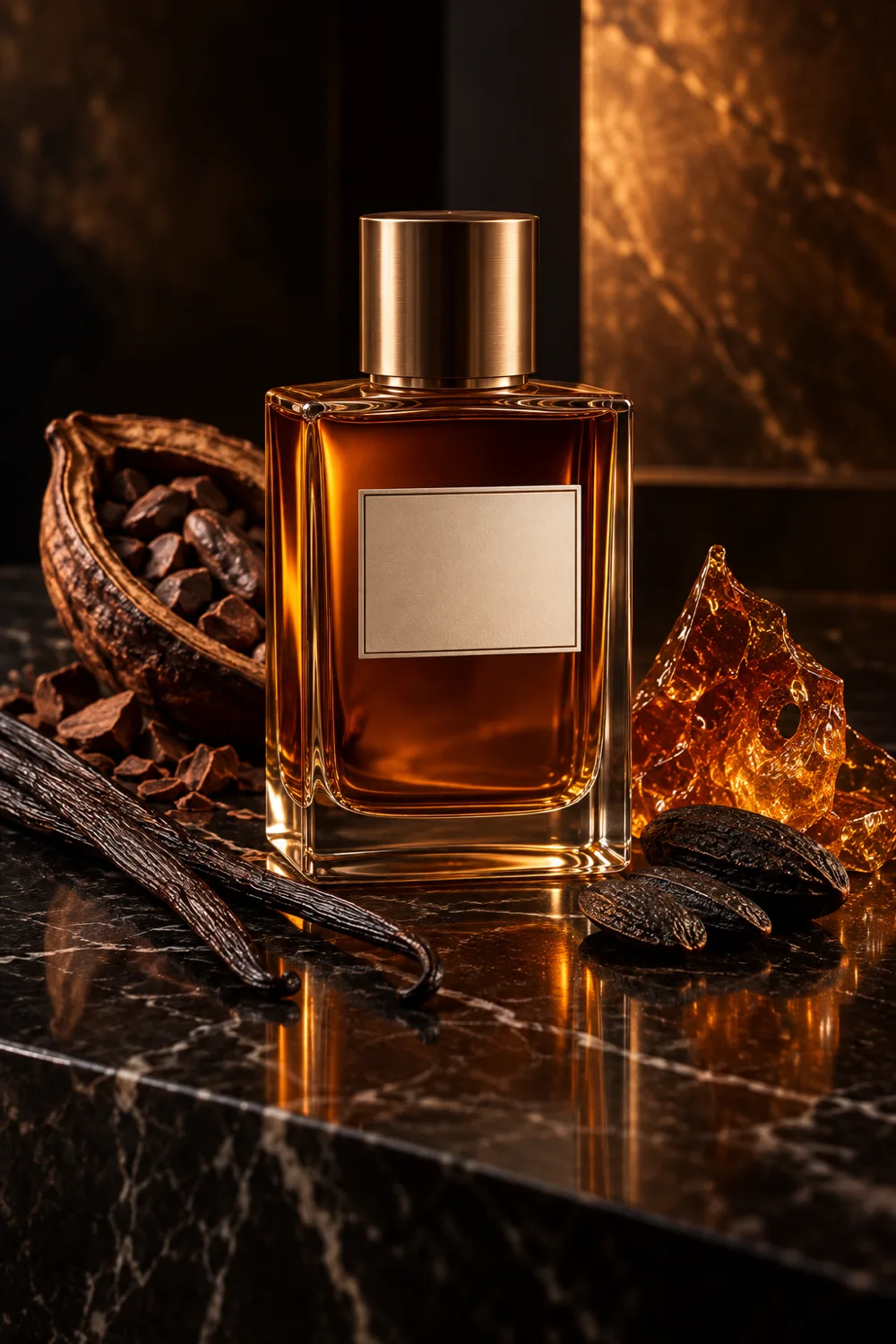
Per Wikipedia’s summary of perfume classification, gourmand fragrances feature “‘edible’ or ‘dessert-like’ qualities, often containing vanilla, tonka bean, and coumarin.” Those three ingredients form the backbone of the category: vanilla for the obvious sweet-warm base, tonka bean for an almond-and-hay depth that reads as slightly less one-dimensional than vanilla alone, and coumarin (found naturally in tonka bean, also produced synthetically) for a soft, hay-like sweetness that ties the whole accord together. From that base, individual gourmand fragrances branch into specific “flavors” — caramel, chocolate, praline, cotton candy, coffee, even bread or cereal-inspired compositions in more experimental releases.
Why gourmand exploded in popularity
A few converging factors explain the category’s rise. Gourmand scents tend to be immediately, universally appealing in a way that’s hard to achieve with more abstract or challenging families — almost everyone has a positive association with the smell of vanilla or caramel, built from a lifetime of food memory, which gives gourmand fragrances an unusually low barrier to entry for a new fragrance shopper. They also tend to test well in the exact short, quick-sniff conditions most people encounter fragrance in — a department store counter, a five-second strip test — since a warm sweet accord reads as pleasant almost instantly, unlike a fragrance that needs an hour of wear to reveal its real character.
There’s also a generational shift in play: gourmand releases have become closely associated with social-media-driven fragrance discovery, where a scent’s initial, immediate impression matters more for building buzz than its multi-hour development does. A fragrance that smells like dessert from the first spray is simply easier to describe and recommend in a short clip or post than a slow-building chypre or a subtle green floral.
Not all gourmands are the same
| Sub-style | Key notes | Character |
|---|---|---|
| Vanilla-forward | Vanilla, tonka, benzoin | Warm, soft, comforting — the gateway style |
| Chocolate/coffee | Cocoa absolute, coffee CO2 extract | Dark, rich, sometimes slightly bitter |
| Confection | Caramel, praline, cotton candy accords | Sweet, candy-like, can skew very young |
| Boozy gourmand | Rum, whiskey, or cognac accords | Warm and sweet with an adult, slightly sharp edge |
| Savory/bread gourmand | Bread, cereal, or nut-adjacent accords | Unusual, less sweet, more textural |
The difference between “vanilla-forward” and “confection” styles in particular matters a lot for wearability: a vanilla-tonka base can be legitimately sophisticated and works in nearly any setting, while a heavy caramel-cotton-candy composition can read as much younger and more casual, worth knowing before wearing one to a professional context. See our guide on work-appropriate fragrance for more on how sweetness level affects that judgment.
Where gourmand notes sit in the note pyramid
Most core gourmand ingredients — vanilla, tonka, benzoin — are base notes, meaning the sweetness typically builds instead of fading over the course of wear, the opposite pattern from a citrus-forward fragrance that’s brightest at the start. See our guide on what top, heart, and base notes mean for the full mechanics. This has a direct practical consequence: a gourmand fragrance that seems only mildly sweet on first application can become considerably sweeter and more concentrated a few hours in, as the lighter top and heart notes fade and the dessert-like base takes over fully.
Layering with gourmand bases
Gourmand bases are some of the most forgiving starting points for a layering routine, discussed in full in our guide on how scent layering works. A light vanilla base pairs cleanly with almost anything — citrus for contrast, florals for softness, spice for depth — because sweetness is such a universally compatible thread. The one common mistake is stacking two already-sweet fragrances together without accounting for how quickly gourmand sweetness compounds; two moderately sweet scents combined can tip into cloying territory faster than two fragrances from most other families would — worth testing a small amount of each before committing to a full-strength combination.
The “does this smell like food, or like a fragrance” question
A frequent worry with gourmand fragrances, especially confection-heavy ones, is smelling like a literal dessert instead of a perfume built around dessert-adjacent notes — a real risk with a poorly balanced formula, but not an inherent flaw of the category. Well-constructed gourmand fragrances balance their sweet elements against something structural: a woody base to add depth, a spice note to prevent flatness, or a touch of something bitter or green to keep the composition from reading as one-dimensional. If a gourmand you’ve tried felt more like standing next to a bakery than wearing a fragrance, that’s a sign of a specific formula’s balance, not a reason to write off the whole family. Reading reviews for terms like “balanced,” “not one-note,” or “well-structured” before buying is a reasonably reliable way to filter for gourmand releases that avoid this trap, since it’s a common enough complaint that reviewers tend to flag it explicitly when a formula gets it wrong.
Gourmand across seasons and occasions
Lighter, vanilla-forward gourmands work reasonably well year-round, but the heavier confection and boozy styles lean naturally toward cold-weather wear — see our guide on building a fall and winter fragrance rotation for how gourmand fits alongside spice and amber notes in a seasonal wardrobe. For gifting, gourmand’s broad, food-driven appeal makes it one of the safer default categories when you don’t know someone’s specific taste — see our guide on choosing fragrance as a gift for more on picking safely when information is limited.
A note on naturalness
Most commercial gourmand fragrances rely heavily on synthetic recreations of food-adjacent smells instead of real food extracts — a “chocolate” note in a fragrance is a constructed accord designed to evoke chocolate, not cocoa butter poured into a bottle. This isn’t a shortcut or a lesser approach; food-derived materials are often unstable, expensive, or simply don’t smell the way you’d expect once isolated and concentrated, and a well-built synthetic accord can read as more convincingly “chocolate” than the real ingredient would in isolated form.
Gourmand and gender marketing
Gourmand notes have historically skewed toward being marketed to women, but that association has loosened considerably as boozy, coffee-forward, and savory gourmand styles have become increasingly common in fragrances marketed as masculine or unisex — see our guide on gender-neutral fragrance for more on how marketing categories track (or fail to track) actual ingredients. A dark, rum-and-tobacco-adjacent gourmand reads completely differently from a pink, cotton-candy-forward one despite both technically qualifying as gourmand, which is a useful reminder that family labels alone rarely predict how a specific bottle will be marketed or perceived.
Budgeting for a gourmand habit
Because gourmand is currently one of the most heavily released categories in the industry, there’s an unusually wide range of quality and price within the family — from inexpensive mass-market vanilla scents to expensive niche gourmand releases built around rare or complex accords. See our guide on building a fragrance wardrobe without overspending for a broader framework, but the gourmand-specific version of that advice is simple: because the category is trend-driven and heavily marketed right now, it’s worth sampling before committing to a full bottle even more than usual, since a scent chasing a current gourmand trend can feel dated faster than a more classic woody or floral purchase would.
The takeaway
Gourmand’s rise from niche curiosity to mainstream dominant family tracks directly with how immediately appealing and easy to describe a good vanilla-tonka or caramel accord is, especially in the short-attention-span conditions most people shop fragrance under today. It’s not a lesser or less serious category than woody or chypre fragrances — it’s simply optimized for a different kind of appeal, one built on food memory instead of abstract scent association. Whether it’s the right family for you comes down to a simple question: do you want your fragrance to remind people of dessert, or something else entirely. Neither answer is more sophisticated than the other — a well-built vanilla-tonka base has as much technical craft behind it as any chypre, it’s simply aimed at a warmer, more immediately comforting effect instead of a complex, slow-reveal one.
The synthetic behind the category’s rise
Much of gourmand’s growth over the past couple of decades traces back to a single synthetic material, ethyl maltol, which produces a cotton-candy, caramelized-sugar effect that’s difficult to get from natural materials alone at an affordable cost. Its wide availability gave perfumers an easy, reliable way to push a formula toward genuine sweetness without relying purely on vanilla or fruit notes, which is part of why gourmand fragrances multiplied so quickly once the ingredient became a standard part of the perfumer’s toolkit. Knowing the name isn’t necessary to enjoy the category, but it explains why so many gourmand releases share a similar underlying sweetness even when their marketing and packaging look completely different from each other.
Source: Wikipedia, “Perfume” — gourmand family definition and composition (vanilla, tonka bean, coumarin).