- Set a small, fixed monthly discovery budget before you start, separate from any full-bottle budget.
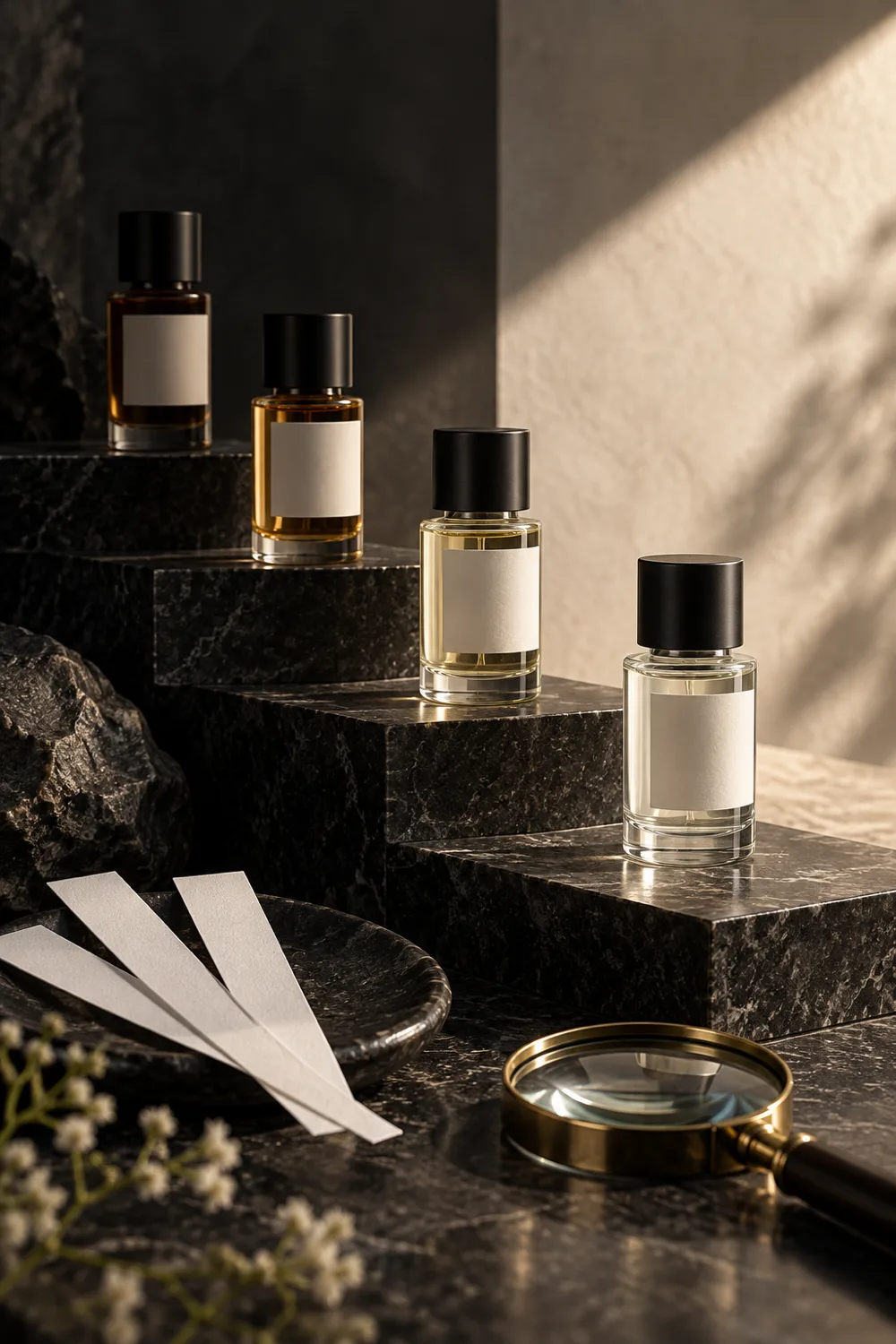
- Sample in batches of 3-5 at a time, not one-offs — it’s easier to compare scents against each other than in isolation.
- Keep a running log of what you’ve tried, with dates and honest reactions.
- Wait at least a week after trying something new before deciding it’s a full-bottle candidate.
- Revisit your log every few months — patterns in what you keep reaching for matter more than any single sample’s first impression.
That’s the routine in outline. The rest of this guide covers why each piece matters and how to build it into a habit that doesn’t quietly become an expensive one.
Why “discovery” needs structure, not just curiosity
Unstructured fragrance discovery — buying a sample here, a decant there, whenever something catches your eye — tends to drift into spending more than a deliberate approach would, for a simple reason: there’s no natural stopping point. A fixed monthly budget creates that stopping point. It doesn’t need to be large; even $15-25 a month is enough to try several new things regularly, and the discipline of a cap matters more than the size of it.
Where to source samples without overpaying
| Source | Typical cost | Best for |
|---|---|---|
| Brand-direct discovery sets | $15-40 for several scents | Guaranteed authentic, correctly stored, good starting point for a new house |
| Third-party decant sellers | $3-15 per scent | Widest selection, especially for pricier niche lines, but verify seller reputation |
| Sample-first subscription services | $10-20/month | Built-in monthly discipline, less control over exactly what you receive |
| In-store testers | Free | Immediate, no shipping wait, but limited to what a given store carries |
| Fragrance swap communities | Cost of shipping, or trade | Trying something a fellow enthusiast already owns, often cheaper than any retail sample |
Mixing sources works well: use in-store testers for anything you can access locally at no cost, and reserve your monthly budget for what you can’t test in person.
Batch testing beats one-off sampling
Trying one new scent in isolation makes it hard to judge — is it worth pursuing on its own merits, or does it just seem interesting because it’s the only thing you’ve smelled all week? Testing 3-5 samples over the same short window, ideally rotating them across different days, gives you a comparison set. A scent that still stands out after being tested against several others is a stronger signal than a single sample tried alone with nothing to measure it against.
What to log, and why it matters more than memory
A simple log beats relying on memory, because a few weeks after trying a dozen samples, the specific ones blur together. Track at minimum: the name and house, the date tested, how it opened versus how it settled after a few hours, and a one-line gut reaction. Note the season and context you tested it in too — a scent tried during a heat wave might read differently than the same scent tried in cooler weather, and that context is easy to forget without a written note. Revisiting this log periodically, instead of trusting your memory of “that one I liked a while back,” is what turns scattered sampling into an actual, useful record of your own taste developing over time.
The one-week rule for full-bottle decisions
A strong first impression from a sample is real information, but it isn’t the whole picture. Waiting at least a week — ideally testing the same sample two or three more times across that window — filters out scents that impress on day one but feel less interesting by the third wear, and surfaces ones that grow on you more slowly. This single habit prevents more wasted full-bottle purchases than almost anything else in a discovery routine, because it removes the impulse-buy window entirely.
Recognizing patterns instead of chasing novelty
The goal of a discovery routine isn’t to try as many things as possible — it’s to build an accurate picture of what works for you. Every few months, look back over your log for patterns: do certain families keep showing up in your favorites? Do you consistently prefer lighter or heavier concentrations? Are there houses whose whole catalog seems to click with you more than others? Those patterns are more valuable than any individual sample, and they should start guiding which samples you bother requesting next, narrowing your discovery process instead of keeping it permanently scattered. For the deeper vocabulary behind these patterns, our guide on the 7 main fragrance families is a useful reference to have alongside your log.
Avoiding the two most common budget leaks
Two specific habits quietly blow up a discovery budget more than anything else. The first is buying a full bottle immediately after a single strong first-wear sample, before the one-week rule has a chance to filter it — this is the single most common source of regretted purchases in this hobby. The second is letting the discovery budget silently expand month over month because “it’s just a small sample” each individual time, without ever adding up the total. Tracking discovery spending the same way you’d track any other recurring expense — a simple running total, checked monthly — catches this before it becomes a real problem.
Turning discovery into a wardrobe, eventually
A discovery routine isn’t meant to run forever without direction — eventually, the patterns in your log should start filling out an actual rotation: a daily-wear signature, a work-safe option, something for special occasions. See our guide on building a fragrance wardrobe without overspending for how to take what you’ve learned through discovery and turn it into a deliberate, budget-conscious collection instead of an ever-growing pile of half-used samples with no destination.
A sample month, worked out
Say your monthly discovery budget is $20. That might cover one brand-direct discovery set ($15) plus a single third-party decant of something you’re curious about but the brand doesn’t offer samples for ($5). Over three months, that’s three discovery sets and three individual decants — somewhere between nine and fifteen new scents tried, logged, and revisited, all for roughly $60 total, a fraction of what even two or three impulse full-bottle purchases would cost if one or two of them turned out to be mistakes.
Building discovery around a theme instead of scattering randomly
Once you’ve done a few months of open-ended sampling, a more focused approach often produces better results than continuing to sample at random: pick a theme for a given month and stick to it. One month might be dedicated entirely to woody fragrances, to see how different houses interpret cedar, sandalwood, and vetiver against each other. Another might focus on one specific house’s full catalog, to get a sense of a single perfumer’s range. This themed approach makes comparisons sharper, since you’re testing genuine variation within a category instead of comparing wildly different things against each other and learning less from each individual comparison as a result.
When to pause discovery entirely
A discovery routine doesn’t need to run continuously forever. If your log shows the same handful of favorites coming up repeatedly over several months with nothing new displacing them, that’s a reasonable signal to pause active sampling and focus your budget on filling out full bottles of what you already know works, instead of continuing to sample out of habit alone. Discovery can always restart later — a new season, a new mood, or simply renewed curiosity are all fine reasons to pick it back up — but treating it as a permanent, unquestioned monthly line item even after it’s stopped surfacing anything new is its own quiet form of overspending.
Quick answers
Is it worth paying more for a bigger sample size? Usually yes, if the price difference is small — a 2ml sample gives a much more honest read on how a scent develops over several hours than a 0.5ml vial that barely covers one wearing.
Should discovery ever include full-price full bottles? No — the entire point of a discovery routine is testing before committing, so a full bottle purchase belongs at the end of the process, once the one-week rule and your own log have confirmed real interest.
How many samples is too many to have open at once? If you can’t remember which vial is which without checking a label, you’re testing too many at once — batches of 3-5 keep the comparison meaningful without becoming overwhelming.
The takeaway
A fragrance discovery routine works best as a small, repeatable habit with real guardrails — a fixed budget, batch testing, a waiting period before committing, and a log that turns scattered sampling into an actual record of your taste. None of this requires spending more than a modest amount each month, and done consistently, it teaches you more about your own preferences than any single expensive purchase could. Start small, keep the log honest, and let the pattern of what you keep reaching for do the deciding — not the excitement of whatever sample just arrived.